








Join in the campaign: When the night sparkles… Keep an eye out for the fireflies and let yourself be enchanted!
Have you ever seen “Gehaansfénkelcher” – fireflies in English? If not, then you’re in for a treat, because the time is approaching – they can be seen at the end of June. And even if you’re one of the lucky ones who’ve already seen these little flying lights on balmy summer evenings – you can’t get enough of them; this natural spectacle never ceases to enchant!
Mouvement Ecologique urges you not to miss this magical moment! Fireflies appear on just a few evenings a year and can be seen in Luxembourg for around two weeks around 24 June. We’ve put together the key facts about these insects and also explain why they’re becoming increasingly rare.
To help you capture the moment, we’ve put together a guide on how to photograph the firefly display. However, capturing the glow on camera isn’t straightforward – long exposure is the key. Have fun trying it out!
Share your experiences and photos with us. See below for more information.
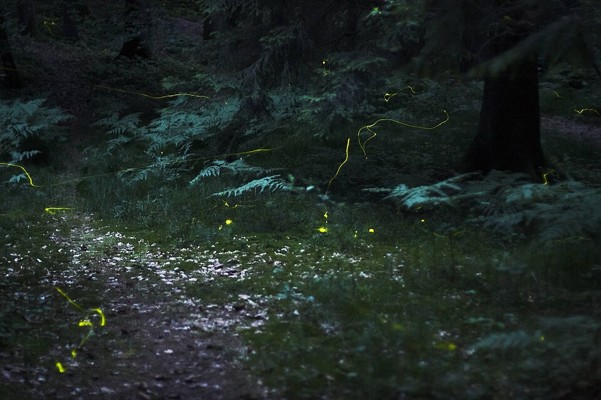
An enchanting spectacle on balmy summer nights – the twinkling of the fireflies “Gehaansfénkelcher” (c) Quit007
What are fireflies and why do they glow?
Fireflies are not worms – they are beetles from the family Lampyridae. Three species are found in Luxembourg: the great firefly (Lampyris noctiluca), the small firefly (Lamprohiza splendidula) and the short-winged firefly (Phosphaenus hemipterus).
The females of all species are flightless and attempt to attract males at night by glowing, so that they can mate. The absence of wings in the females, as well as their elongated, segmented body shape, has earned them the name ‘worms’. In the case of the small firefly, the males also glow – so any flying points of light in our region can always be attributed to this species. The males of the large firefly, on the other hand, do not possess functional light-producing organs. Although both males and females of the short-winged firefly can glow, they do so only very faintly and only when disturbed. They are also both flightless.
The larvae of all three species also glow, though the biological purpose of this is not yet fully understood, as it does not yet serve mating purposes at this stage. It probably serves as a deterrent to predators.
The substance that amazes us: luciferin
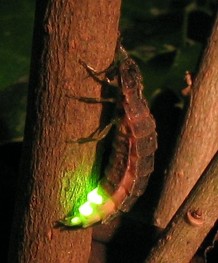
Female of the Great Stag Beetle (C) Wofl commonswiki
Fireflies produce what is known as ‘cold’ light, which is not generated by heat. They possess a luminescent substance called luciferin, which is made to glow when combined with the enzyme luciferase and oxygen. In this process, 98% of the energy released is converted into light. By way of comparison: LEDs achieve an efficiency of around 50%, traditional light bulbs a mere 5% – fireflies are therefore far superior to human technology!
When can you spot them – and why are they called ‘Gehaansfénkelcher’ in Luxembourgish?
Fireflies can be seen mainly between 10:15 pm and midnight, and are best observed during a new moon. Their glow coincides precisely with the period around St John’s Day (24 June) – hence the Luxembourgish name ‘Gehaansfénkelcher’: ‘Gehaans’ stands for John (as in ‘Gehaansdag’, St John’s Day), whilst ‘Fénkelcher’ means ‘little sparks’. They are therefore the ‘St John’s sparks’ – tiny lights that herald the summer solstice.
The fireflies currently visible are mainly the large and small fireflies. The short-winged firefly only mates in late summer and then glows only faintly in the middle of the night.
A spectacle that is becoming increasingly rare
In the past, fireflies glowed on summer evenings along many paths and forest edges – today, you must look hard to find them. The three most common causes of their decline are habitat loss, pesticides and light pollution.
Artificial light from settlements and roads particularly disrupts mating behavior: night-time lighting not only disrupts the beetles’ biorhythms but, above all, interferes with their mating rituals – the males simply can no longer find the glowing females.
The loss of near-natural habitats affects fireflies just as much as many other insects. They need structurally rich landscapes with scrubby edges, richly varied forest edges and unmown verges – elements that are becoming increasingly rare in our countryside and urgently need to be promoted and restored. Other animal species that Mouvement Ecologique has highlighted in previous campaigns – such as hedgehogs, garden dormice and brown hares – are dependent on the same structures. The firefly thus serves as a prime example of how entire communities suffer from the same causes.
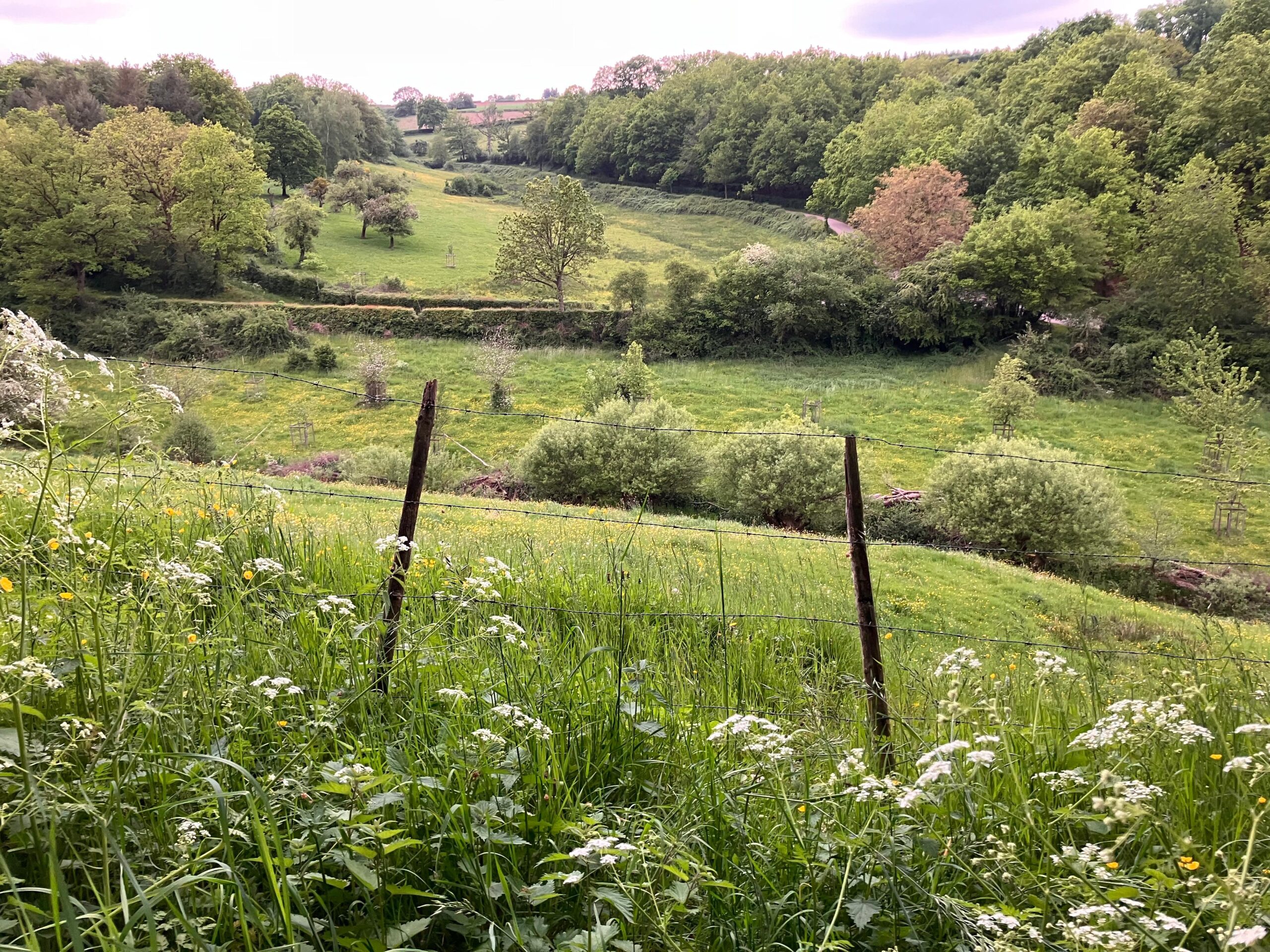
Fireflies should be found in this landscape: the mix of woodland, forest edges, unmown verges and unfertilised meadows – far from artificial light sources – provides a good habitat
The direct impact of pesticides is particularly alarming: studies show that many conventionally used pesticides harm fireflies. In one experiment, for instance, the number of adult fireflies fell by around 70% when the seed was treated with the neonicotinoid clothianidin. This active ingredient has, quite rightly, not been authorized for agricultural use in this country for a few years now. Yet it clearly illustrates the problem: although fireflies are beneficial insects (the larvae eat snails), these pesticides do not act selectively against the targeted pests alone. They affect everything – and often as early as the larval stage, which fireflies spend up to three years in the soil.
Capture the firefly dance on camera – and share it with us
Instructions for firefly photos
When the night sparkles… Fireflies appear only a few evenings a year and can be seen in Luxembourg for around two weeks around 23 June. It’s a magical moment not to be missed! Here’s how to capture their light without disturbing them.
1. Choose the right moment
- Wait for a warm, windless night, just after sunset.
- Come out quite late, when it’s properly dark — around 11 pm in June.
- Avoid lamps or flashes: artificial light scares them away.
2. Find the right spot
- Choose a forest or a meadow with tall, uncut grass.
- Fireflies like quiet, natural areas near hedges or trees.
- Settle down comfortably, without trampling the vegetation.
3. Prepare your camera
- Use a tripod to avoid any movement.
- Set your camera to manual mode:
- ISO: 400 to 1000
- Aperture: f/1.4 to f/4
- Exposure time: between 5 and 20 seconds
- Focus: manual, on an area about 2–3 metres away
- Focus manually whilst there is still some light (twilight).
- Choose a fixed point at the distance where the fireflies will be flying (a branch, a stone, tall grass).
- Once the focus is set, turn off autofocus so that it doesn’t move.
The longer the exposure time, the more visible and artistic the fireflies’ light trails will be. But beyond 20–30 seconds, the image may become too bright or lose contrast. Try out different exposure times to find the right balance.
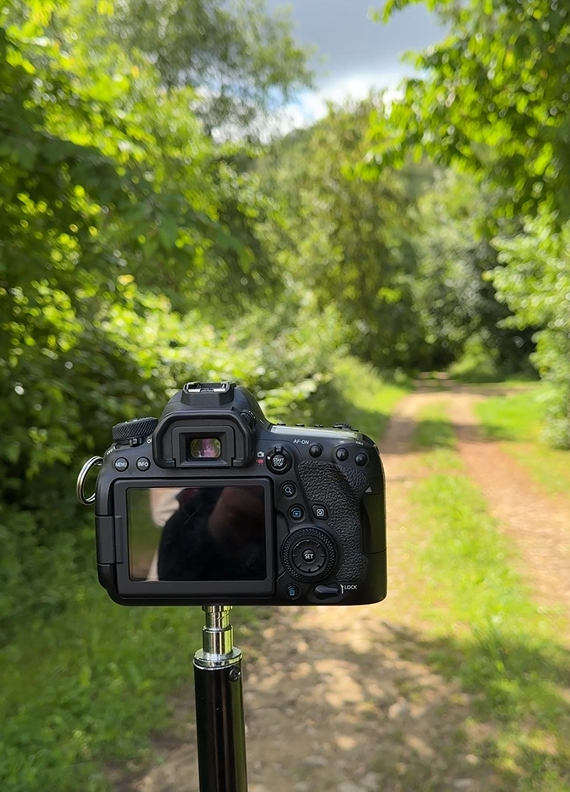
4. Take the shot without touching the camera
To avoid moving the camera whilst taking the shot:
- Use a remote control (wired or Bluetooth).
- Or connect your smartphone to your camera via the manufacturer’s app (Canon Camera Connect, Nikon SnapBridge, Sony Imaging Edge…).
- If you don’t have a remote control or a mobile connection, set the self-timer to 2 to 5 seconds.
5. Capture the magic
- Leave the camera open for several seconds so that the points of light trace their paths.
- Try taking several shots to vary the effects — sometimes, a single firefly is enough to create a magical image.
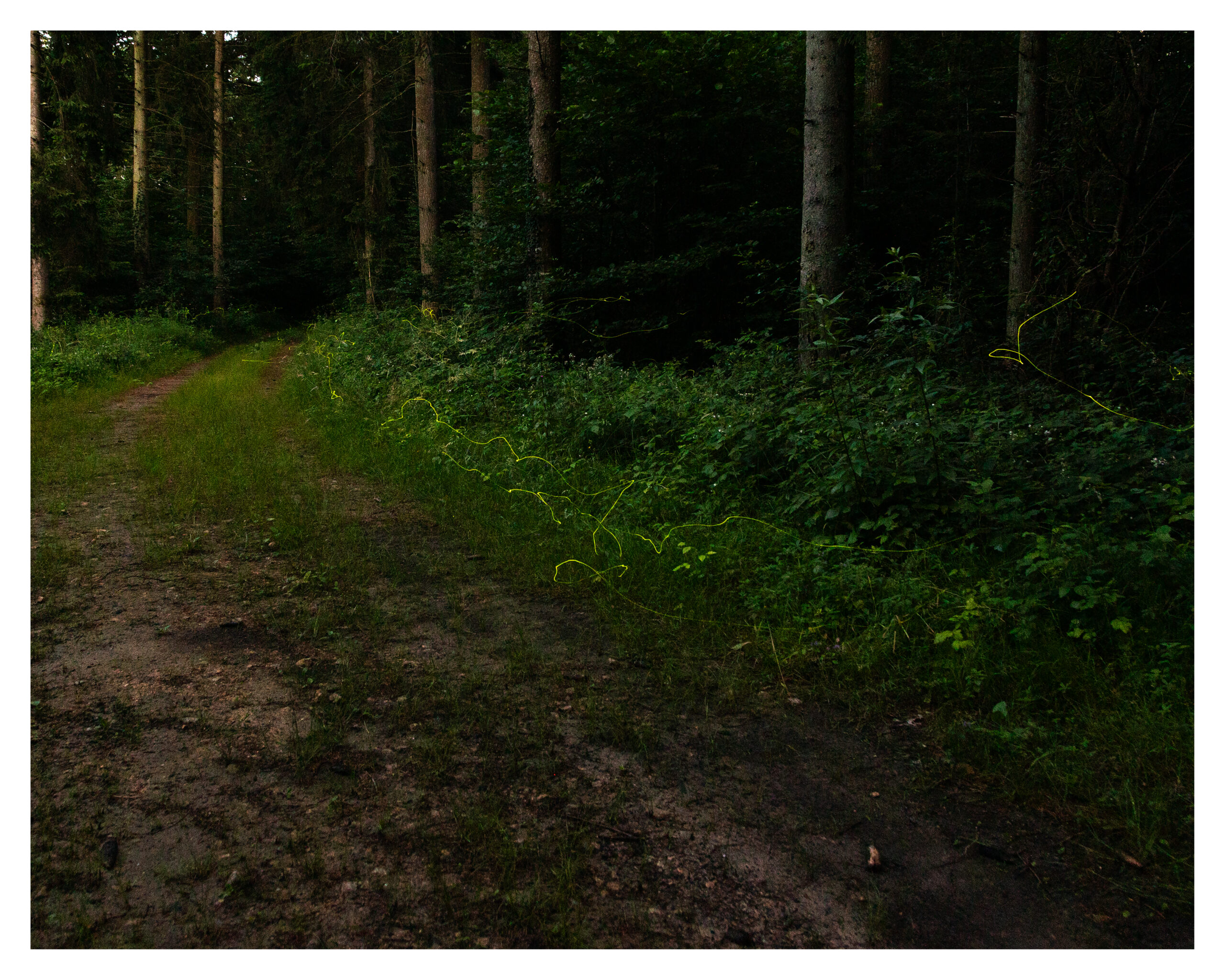
(c) Dording Claude
6. Respect nature
- Do not touch the fireflies or shine a light directly on them.
- Observe, take photos, and let the forest retain its mystery.
✨ Share your photos by e-mail at natur@oeko.lu or on Social Media with the hashtag #Fireflies and help spread the word about these wonders of our Luxembourg nights.
During our night walk (in luxembourgish) on 20 June, we’ll be demonstrating live on site how these photos can be taken.
15.06.26