







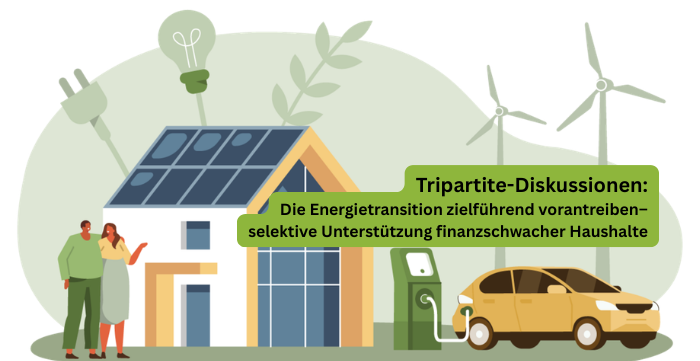
Tripartite Discussions: Advancing the Energy Transition Effectively – Targeted Support for Low-Income Households
“We need to deal with the crisis now – saving the planet can wait…”?
With this provocative statement, Dr. Felix Matthes, Research Coordinator for Energy and Climate Policy at the Berlin office of the Oeko-Institut, opened a lecture on 19 April 2022 addressing how to respond, in the energy sector, to the consequences of Russia’s invasion of Ukraine.
At the time, the primary political response was clear: energy prices should be artificially kept low through substantial public subsidies, while the energy transition could be addressed at a later stage.
However, the multiplication of geopolitical crises and the destabilisation of additional regions of the world demonstrate that the longer dependence on fossil fuels continues, the more public finances come under pressure and the more structural transformation is delayed.
Admittedly, today’s discussions are more nuanced than they were in 2022. Today, all stakeholders support a stronger expansion of renewable energy and the advancement of the energy transition. Agricultural actors are also, encouragingly, calling for a rethink of certain dependencies, for example regarding imported animal feed.
Yet, since Russia’s invasion of Ukraine, the state has invested considerable financial resources in “stabilising” or lowering energy prices. At the same time, major energy transition objectives continue to be missed. The heating transition, meaning the move away from fossil fuels for heating, is progressing extremely slowly, leaving Luxembourg far behind the targets set in the National Energy and Climate Plan (NECP), with estimates suggesting a gap of around 80%. Similarly, despite some positive developments, targets for electric mobility remain far from being achieved.
The mobilisation of significant public funds to reduce or stabilise prices in the short term must not come at the expense of structural climate and energy reforms, nor should it send counterproductive signals, such as indirectly supporting fossil-fuel-powered vehicles. Structural reforms are precisely what would strengthen resilience to geopolitical crises and help achieve climate objectives.
Instead of a Blanket Approach: Invest Public Funds in Real Reforms and Support for Financially Vulnerable Households
No one welcomes higher energy bills. However, energy has a cost, and according to the broad consensus among economists, prices should generally reflect reality.
It is self-evident that people with lower incomes must be supported. What is not justified is using public funds to guarantee low energy prices for all households regardless of income.
The Mouvement Ecologique therefore believes that any analysis of the relief measures agreed upon within the Tripartite framework should be guided by three key principles:
- Decisions must not undermine the objectives of the energy transition. Neither households nor businesses should receive incentives that call into question the goal of progressive decarbonisation. This means no general reduction in the prices of fossil fuels such as gas, heating oil, or motor fuels.
- Compensatory measures should be introduced for low-income households to prevent them from bearing a disproportionate burden from the energy crisis.
- Luxembourg must finally accelerate the energy transition so that the country does not face the same debates again during the next crisis.
Transparency Matters: Publish the Key Documents Used in the Tripartite Discussions
At first glance, the current Tripartite process appears more transparent than previous rounds. For example, several documents produced by STATEC are publicly available on government websites, which is a positive step.
However, according to information available to the Mouvement Ecologique, additional STATEC calculations exist regarding the impact of specific energy price increases on the wage indexation mechanism. These calculations are highly relevant to the debate.
It is therefore essential that the projected impacts of possible price developments for electricity, gas, heating oil, petrol and diesel be made publicly available. Unfortunately, this is currently not the case.
Possible Relief for Electricity Prices: Yes – Support for Fossil Fuels Only for Vulnerable Households
The Mouvement Ecologique supports public intervention regarding electricity prices because electrification is central to the energy transition. Increased use of electricity, for example for heat pumps and electric vehicles, must remain attractive compared to fossil fuels.
There is, however, no justification for artificially keeping fossil fuel prices low for everyone. Prices should reflect their real costs as much as possible. Nevertheless, financially vulnerable households must not be left alone to face rising costs. Targeted support measures should therefore be implemented, such as a mobility tax credit (“crédit d’impôt mobilité”), as proposed by trade unions.
Beyond Crisis Management: Finally Deliver the Energy Transition
As highlighted above, Luxembourg is still lagging significantly behind in implementing a genuine energy transition.
While progress has been made in areas such as solar energy deployment and the pre-financing of photovoltaic installations, the country remains far from achieving carbon neutrality by 2050.
The Mouvement Ecologique therefore calls for:
- A genuine heating transition strategy, including stronger support for heat pumps, heat networks, pre-financing mechanisms, and lower electricity taxation for heating applications.
- A comprehensive renovation strategy for existing buildings, including vacant properties, instead of continued reliance on new construction.
- A revised Klimabonus Wunnen scheme based on transparent calculations and social fairness.
- A dedicated strategy to improve energy renovation in multi-family buildings and rental housing.
- The effective implementation of Luxembourg’s Climate and Social Plan.
- The rapid introduction of social leasing schemes for electric vehicles and heat pumps.
- Stronger and more targeted support for households most affected by the energy crisis.
Strengthening the Independence of Agriculture
The Mouvement Ecologique also advocates:
- Reforming agricultural subsidies according to the principle of “public money for public goods.”
- Expanding the Supply4Future concept to all public canteens.
- Much stronger support for organic farming, which reduces dependence on imported fertilisers and strengthens resilience.
- Greater engagement at Benelux and EU level to challenge trade agreements that further expose local agriculture to global market pressures.
The Energy Crisis Also Requires Institutional Reform
Finally, the energy transition requires reforms in governance and planning:
- Better statistical data to enable more targeted and effective support policies.
- More human resources and stronger prioritisation within public administrations.
- Improved cooperation between ministries, particularly between the environment, economy and agriculture portfolios.
- A broad and inclusive dialogue involving all stakeholders to ensure a socially just and effective energy transition.
Translated by Deepl.
6 June 2026.