








Greater biodiversity – more wild bees Report on the conference ‘The Secret Life of Wild Honeybees’
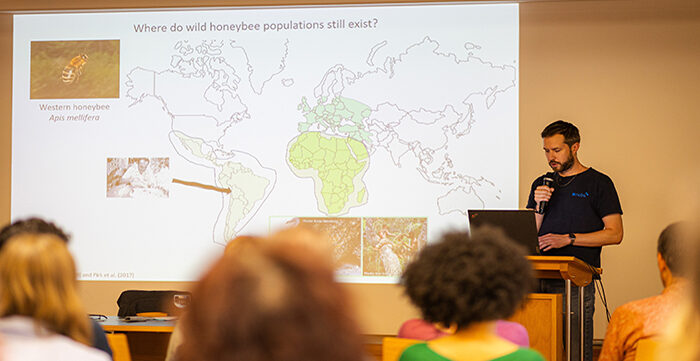
Report on the conference ‘The Secret Life of Wild Honeybees’ held on 4 May 2026 with Dr Benjamin Rutschmann.
Around 40 people attended the conference, which was jointly organised by Mouvement Ecologique (Meco) and Honey Bee Wild Luxembourg (HBWLux).
In his introduction, Roger Dammé briefly outlined the origins of the initiative to search for and observe wild honey bees in Luxembourg in 2018. Around 90 nests have since been found, although around a third of these have since been destroyed (trees felled or fallen over, building facades sealed off, etc.).
Since 2025, wild honeybees have been classified as ‘endangered’ in the EU. Data collected over several years in Luxembourg, which was passed on by HBWLux to the International Union for Conservation of Nature (IUCN), has contributed to this classification. Thanks were extended to the volunteers who take part in monitoring the known nests three times a year.
Decline in wild bee colonies
As the ecologist and bee researcher Dr Benjamin Rutschmann explained in his presentation, the number of managed honeybee colonies continues to rise worldwide. At the same time, available data from Africa and North and South America point to a decline in wild populations. In Europe, too, studies from seven countries (CH, DE, ES, FR, LU, PL, UK) paint a similar picture. Overall, the population trend for wild honeybees is viewed as predominantly negative, which is reflected, among other things, in the IUCN’s classification of them as ‘Endangered’.
Large, old trees – the preferred habitat
Researching these populations is proving difficult. Wild honeybees often live hidden away in so-called ‘bee trees’ – large, old trees with hollows of at least 30 litres in volume. Such nesting sites are often found in dense forests and are correspondingly difficult to track down. Particularly in extensive beech forests, the search for occupied tree hollows therefore often resembles the famous search for a needle in a haystack.
Citizen science projects are designed to help gather more data on wild honey bees. Yet here too, the challenge of obtaining reliable and scientifically robust information is considerable.
Several factors play a role in the survival of wild honeybees. The lack of suitable resources is particularly significant. High biodiversity in open countryside is considered a key prerequisite for sufficient food. Interestingly, studies show that wild colonies often have a lower parasite burden than beehives from apiaries.
In their search for suitable cavities, honeybees compete with other animal species. Competition for suitable nesting sites is further intensified by the lack of old trees with sufficiently large hollows – those now rare ‘bee trees’ that are vital for the survival of wild honeybees. The protection of habitats, particularly large and old trees, is therefore a key priority.
Joint appeal: Stop the destruction of wild honeybee nests
During the conference, reference was also made to a joint letter from the Luxembourg National Beekeeping Association, HBWLux and Meco to the Ministers for Agriculture and the Environment. In it, the three organisations call on the government to finally amend a Grand Ducal regulation that mandates the destruction (!) of wild honeybee nests.
Foto & Video (c) Honey Bee Wild Luxembourg & Mouvement Ecologique
Presentation (c) Dr. Benjamin Rutschmann


18.05.26