







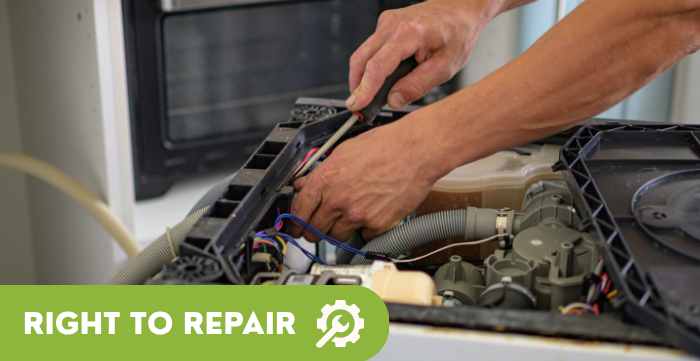
“Right to Repair” is now also enshrined in law in Luxembourg!
Very positive approaches – but there is room for improvement
The right to repair is an essential approach to countering the throwaway society and planned obsolescence (i.e. the deliberate shortening of the lifespan of products).
Now is an important time to strengthen this right for consumers. Indeed, less than two months before the deadline set by the EU for transposing an EU directive, the government has presented a draft law that largely implements the directive to strengthen the right to repair.
The directive contains a number of very positive approaches: In particular, provisions are intended to ensure that manufacturers will no longer be able to obstruct repairs through technical or software-related means. The extension of the periods for consumers to identify defects in products and of the guarantee period is also to be welcomed.
However, for the right to repair to actually be effective, simply transposing the EU directive into national law is not enough. What is crucial are concrete framework conditions that make repairs attractive and accessible compared with buying new products.
The Mouvement Ecologique therefore sees a particular need for action in the following areas:
Luxembourg should advocate at European level for further development of the directive
Stricter requirements are needed above all for products sold via online marketplaces by providers from outside the EU (e.g. Temu). For these products, the right to repair can remain largely theoretical due to unclear requirements. These platforms are required to appoint a representative within the EU who is theoretically supposed to ensure compliance with EU law. At the same time, however, the directive does not specify how these representatives are to implement the right to repair in practice, making their implementation highly uncertain.
Furthermore, the scope should be extended to additional product categories, in particular small household appliances. The existing regulation only applies to larger household appliances (e.g. refrigerators and washing machines). Similar provisions would also be important for smaller household appliances (e.g. coffee machines), which could often be repaired as well.
Luxembourg’s repair culture needs stronger support
Cooperation with professional repair businesses, as well as the role of resource centres in reuse and spare parts, should be strengthened in this context. The draft law does not represent any progress in this area.
But “Repair Cafés” and other civil society initiatives also make an important contribution to repair, knowledge sharing and awareness-raising. They should have better access to repair information and spare parts – currently, these elements are reserved for commercial repairers. Volunteer repairers could also benefit from this. Access to repair information can thus even improve the safety of repairs.
Repair expertise must be preserved and further developed. The repair sector faces challenges in attracting new professionals while also having to keep pace with the increasing technical and software-related complexity of devices. Repair should therefore be more firmly integrated into vocational education and continuing training, and the profession of repairer should be given greater recognition.
A national repair bonus and further incentives for repair should complement the law as soon as possible
To date, 50 municipalities have introduced a municipal bonus (see www.oekotopten.lu). This municipal initiative is highly positive. However, a national bonus should be introduced. Such a bonus would reduce costs as the main obstacle to repairs, ensure equal access for all citizens (regardless of whether their municipality takes the initiative or not), and relieve municipalities of the currently differing levels of municipal support. Financing the repair bonus by manufacturers rather than by public funds, following the example of France, should also be examined. In addition, extending the super-reduced VAT rate of 3% to certain repair services should be considered.
Implementation must be accompanied by clear guidance and systematic monitoring
The law aims to keep the price of repairs as low as possible and prevent any “excesses”. However, the terms “reasonable price” and “reasonable duration” of a repair in particular require more concrete interpretation. An interpretative guide could provide consumers and repair businesses with greater certainty. At the same time, data on repair prices, spare-parts costs and consumer behaviour should be collected regularly in order to assess the effectiveness of the measures and make adjustments where necessary. This information policy by the responsible ministries should be better regulated by law.
Finally, permanent awareness-raising is needed
The government states that, in parallel with the adoption of the law, it will conduct a campaign informing consumers about their new rights.
This should be the starting point for continuous communication and should inform consumers in particular about the information already available on the repairability and durability of products. The oekotopten.lu portal can play an important complementary role here.
The draft law is an important step – however, Luxembourg is already behind schedule with its implementation, as this should have taken place by 31 July 2026 at the latest.
The Mouvement Ecologique calls on the government, however, to go beyond merely transposing the European requirements and to create the necessary framework conditions for a genuine repair culture now. Only through concrete financial incentives, strengthening the repair sector and civil society initiatives, as well as continuous awareness-raising and evaluation, can the right to repair become genuinely embedded in consumers’ everyday lives.
06.10.2026