





Planned reform of company car taxation and the introduction of ‘social leasing’ for electric cars
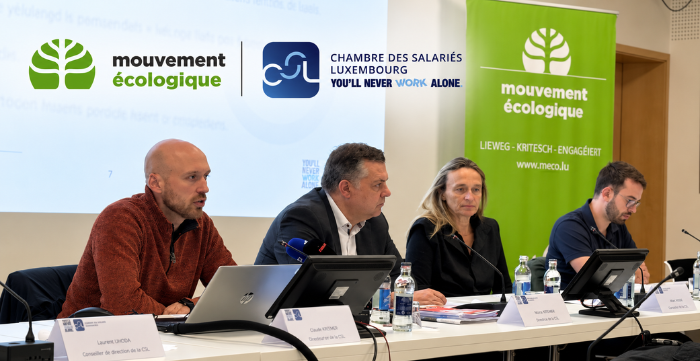
The Chamber of Employees and Mouvement Ecologique are calling for improvements in line with the socio-ecological transition.
Having already worked together on the ‘Climate and Social Plan’ in recent years, the two organisations are now campaigning for the government to make further amendments to two key proposals, some of which are either highly problematic from an environmental perspective (the overhaul of the company car scheme) or where there is significant scope for improvement from a social perspective. This is in line with the motto ‘Thinking about social and environmental issues together’.
The transport sector accounts for around 60 per cent of Luxembourg’s CO₂ emissions. In addition to expanding bus, rail, walking and cycling services, as well as car-sharing and carpooling schemes, the switch from internal combustion engines to electric cars is essential. Currently, only 14 per cent of vehicles are electric (the PNEC target also includes plug-in hybrids, which currently account for 4.1 per cent), but according to the Climate and Energy Plan, this figure is set to rise to 49 per cent by 2030. We are therefore still a long way from the targets set. As ever-better and more affordable electric vehicles come onto the market, this development will be driven primarily by fully electric vehicles.
To ensure that the transition is environmentally effective and socially just, subsidies must be clearly targeted, calculated in a transparent manner and accessible to people on low incomes. It is precisely the latter group who suffer most from rising energy prices. They are particularly vulnerable to these price rises because they lack the financial means to participate in the energy transition.
- Company car taxation: Planned changes would represent a significant step backwards
The government plans to make plug-in hybrids (PHEVs) a more attractive option as company cars in future than has been the case in recent years. From a climate protection perspective, this would be an absolutely wrong decision. The main reason: their actual CO₂ emissions in everyday use are far higher than stated. Independent studies show that real-world emissions exceed manufacturers’ figures by up to six times . Furthermore, they cement dependence on fossil fuels and, due to having two propulsion systems, are resource-intensive and costly to maintain.
The planned increased incentives would also contradict the provisions of the Climate Bonus for Mobility and social leasing schemes. These support schemes apply exclusively to fully electric vehicles and, for good reason, exclude plug-in hybrids from state support. In this draft, the government refers to a proposed European regulation designed to significantly reduce emissions from plug-in hybrids in practice, regardless of driving behaviour. However, this regulation is currently being strongly challenged at EU level by industrialised nations, including Germany. Without this regulation and the resulting reduction in emissions from plug-in hybrids, the planned preferential treatment would be even more illogical.
The planned increased tax relief for plug-in hybrids used as company cars should therefore be withdrawn.
Furthermore, the benefits in kind (‘avantage en nature’) for company cars are already a special privilege that primarily benefits a relatively small group of high-income employees – and should be critically scrutinised from this perspective alone. It is incomprehensible that public finances would be further burdened by this preferential treatment of an ‘outdated’ technology. Tax incentives and direct subsidies must coherently support the transition to fully electric cars. Public funds should be prioritised for socially equitable electrification, in particular social leasing and high-capacity charging infrastructure.
- ‘Social leasing’: Good approaches, but in need of significant improvement
Mouvement Ecologique and the Chamber of Employees expressly welcome the planned introduction of social leasing for electric cars as a key measure under the Climate and Social Plan. It is certainly also to be welcomed that the government has opted for a single, clear income criterion for social leasing, rather than, as is the case in France, for example, taking additional factors such as the distance to the workplace into account.
Nevertheless, both organisations see a clear need to do more to reach all low-income households as effectively as possible and to strengthen the impact of this scheme:
- Expanding access: The draft bill stipulates that only those households that are actually recipients of the ‘complément de vie chère’ (CVC) are entitled to an electric car under the ‘leasing social’ scheme. The Chamber of Employees and Mouvement Ecologique advocate that all households entitled to the CVC should be able to benefit from the ‘leasing social’ scheme – regardless of whether they have applied for or received the benefit.
- No flat-rate household limit: The current provision is that only one person per household is eligible. This restriction should be lifted (varying work, childcare and care responsibilities may necessitate multiple vehicles).
- Equality for single parents: At present, single parents are disadvantaged, as less efficient seven-seater electric cars are only eligible for households comprising two adults and three children.
- Transparency of costs: It is not clear how the subsidy amounts and leasing instalments were calculated. Furthermore, not all costs, down payments, fees, included services and contractual terms have been disclosed. This information should be published immediately, as this is the only way to ensure the government’s proposals are transparent. The state must carry out an analysis of the leasing contracts so that it can intervene where necessary in the event of excessive prices or ‘hidden’ costs.
- Inclusion of cross-border commuters: Under the draft legislation, cross-border commuters cannot benefit from social leasing, even though they are often disadvantaged by low incomes and particularly long journeys to their place of work. Furthermore, they make an important contribution to the country’s development, both economically and in terms of taxation, and should therefore be taken into account accordingly.
In addition to these points, charging costs should also be taken into account: here, additional support is needed for households without private charging facilities, for example through pre-funded charging infrastructure, more charging points in blocks of flats, and vouchers or direct charging credits.
A further aim of social leasing should be to create a dynamic second-hand market for electric cars – in this regard, it should be examined whether a purchase option can be offered after three years without driving up leasing prices. In doing so, it should be ensured that returned vehicles benefit the Luxembourg second-hand car market as far as possible.
- Allocate sufficient budgetary resources for the socio-ecological transition
For 2027–2032, €77.94 million has been earmarked for social leasing – an average of around €13 million per year. This is intended to reach only around 7,800 households, even though around 44,000 households are expected to meet the CVC eligibility criteria in 2027. Compared with general funding for electric cars, the financial resources remain modest and the expected reach limited.
The social leasing scheme must be made more ambitious, the group of eligible recipients expanded, and the budget increased accordingly. Even so, the social leasing scheme will use up virtually all the budgetary resources earmarked for implementing the 44 measures of the Climate and Social Plan. Yet the remaining 43 measures are also of central importance. The government must set out transparently how all the measures in the Climate and Social Plan (‘Plan social pour le climat’) will nevertheless be financed. The socio-ecological transition must be established as a clear priority in the national budget and allocated sufficient funding.
- For a technically sound, targeted and socially differentiated funding policy
Both drafts exhibit fundamental weaknesses: the objectives, target groups, funding levels and expected impacts are not sufficiently transparent. For future funding programmes, the CSL and the Mouvement Ecologique therefore call for:
- Clear objectives and success criteria: Bindingly define expected CO₂ savings, contributions to climate targets and measurable success indicators.
- Reaching target groups and removing barriers: Give explicit consideration to particularly vulnerable households and investigate and remove barriers such as a lack of own funds or restricted access to credit.
- Justify funding levels and apply a social sliding scale: Back up funding amounts with robust, transparent calculations, assess their appropriateness and take greater account of households’ financial circumstances.
- Comprehensively assess impacts: Examine the possibility of phasing in funding over time and systematically analyse not only environmental impacts but also social and economic consequences.
- Coordinate policy instruments: Link funding to clear information, charging and other infrastructure, regulation and affordable alternatives.
The government must amend both draft bills accordingly. Only a technically sound, coherent and socially just subsidy policy can effectively drive forward the mobility transition and enable everyone to participate in the socio-ecological transition.
21 October 2026