








Microplastics in the environment from tyre wear – tips for reducing pollution
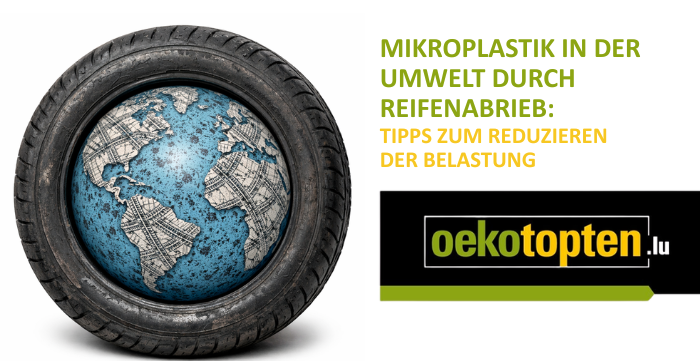
When it comes to plastic in the environment, many people think primarily of packaging, but tyre abrasion also plays a significant role! It cannot be completely avoided when driving, but it can be reduced considerably. Oekotopten.lu offers some practical tips that can be taken into account, especially when changing tyres.
Previous studies by the Fraunhofer Institute have already classified tyre abrasion as a significant source of microplastics. Updated and new scientific analyses now largely confirm this assessment. The results are alarming: particles from tyre and road wear – TRWP (Tyre and Road Wear Particles) for short – are among the largest sources of primary microplastics in the environment, especially in industrialised countries with heavy traffic.
Studies and material flow analyses – including those conducted by BOKU, the University of Natural Resources and Life Sciences, Vienna – also show that tyre wear in road traffic is the largest source of microplastic emissions. This is because TRWP enter ecosystems via the air, soil, rainwater runoff and waterways and can accumulate in sediments and food chains – and thus also in the human body – over the long term.
TRWP – more than just microplastics
The core message of earlier studies has not changed, but the analyses have become more precise. It is interesting to note that TRWP is not only made of rubber. The particles are composed of a compressed mixture of rubber, carbon black, metals, road material and other additives.
That is why there is increasing research into how plastic abrasion can be reduced through road construction measures, e.g. optimised road surfaces, filter systems in road drainage, green retention systems and road cleaning. Although these measures cannot prevent plastic abrasion, they can significantly reduce its spread in the environment and waterways and are therefore considered an important complementary strategy for reducing emissions in the transport system.
Reducing tyre abrasion through appropriate driving style
Tyre abrasion is caused by mechanical friction between the tyres and the road surface. However, it is well known that the amount of abrasion does not depend solely on the type of tyre, but also on other factors such as:
- Vehicle weight and engine power
- Driving style (acceleration, braking, cornering)
- Tyre pressure
- Road surface and temperature
- Tyre width and dimensions
These factors often have a greater influence on abrasion than the mere distinction between summer, winter or all-weather tyres. Nevertheless, the latter are also important.
So if you want to help reduce plastic particles in the environment, don’t drive fast, drive with foresight so that frequent braking is less necessary, slow down in bends, etc. The optimum tyre pressure for most cars is usually between 2.0 and 3.0 bar. You can find the exact specifications on a sticker in the fuel cap, on the driver’s door or in the manual. This is a very simple way to reduce tyre abrasion, which also goes hand in hand with safe driving.
The right tyres – not a panacea, but one important measure among many
To come straight to the point: fit winter and summer tyres, as this also reduces wear. All-weather tyres are not recommended in terms of reducing plastic abrasion.
All-weather tyres are, by design, a compromise between summer and winter tyres. This is usually achieved by using a softer rubber compound than in pure summer tyres to ensure sufficient grip even at low temperatures. However, this means that above approx. 15°C, all-weather tyres tend to wear more quickly, i.e. plastic abrasion, than summer tyres. There is no exact fixed temperature limit scientifically, but there are well-documented temperature ranges.
The 7-degree rule serves as a guideline: below ~7 °C, winter or all-weather tyres have an advantage (they are also more wear-resistant). At temperatures consistently above around 7 °C (often in the range of 10–15 °C and above), winter and softer all-season tyres become increasingly softer on warm roads, which leads to higher wear and thus potentially increased abrasion. 10 to 15 °C can be considered a transition range. Above ~15–20 °C, all-weather tyres usually start to wear out faster than summer tyres.
EU tyre label – still no decision-making aid for the problem of ‘abrasion’
Since 2021, the current EU tyre label has been informing consumers not only about rolling resistance (energy efficiency) and wet grip (safety) with classes from A (best class) to E (worst class), but also about external rolling noise in decibels.
Unfortunately, however, microplastic emissions are not included, which, together with information on tyre abrasion, could also provide information about the tyre’s service life.
However, the EU plans to use the Ecodesign Directive to integrate additional environmental parameters, such as tyre abrasion and mileage, into consumer information in the future. However, this requires standardised and reliable measurement methods. Data on mileage and abrasion performance would be included as soon as a test method is available. In future, information on mileage, abrasion, retreaded tyres and snow and ice grip will be added to the labels.
26.02.26