







Breaking free from the sword of Damocles of arbitration tribunals: Luxembourg must exit toxic clauses and avoid signing new treaties that contain them
The Fridman case has starkly highlighted the risks posed by investment agreements: by filing a claim for 16 billion US dollars against Luxembourg, the Russian oligarch was able to secure his removal from the European sanctions list in the context of the war against Ukraine — even before the case had reached a judgment! This case illustrates how vulnerable Luxembourg, as well as the rest of Europe and beyond, have made themselves to blackmail by private investors, oligarchs and others. Environmental and development NGOs have been calling for a change of course in international policy in general, and investment agreements in particular, for several years. The disastrous Fridman case must serve as a wake-up call to ensure that states are no longer subjected to these rules, which are highly problematic from an ecological, social and democratic perspective.
Following the Global Action Days from 15 to 17 October, Mouvement Ecologique and ASTM are taking action, alongside many other European and international organisations.
A risk to public policy, even without a ruling
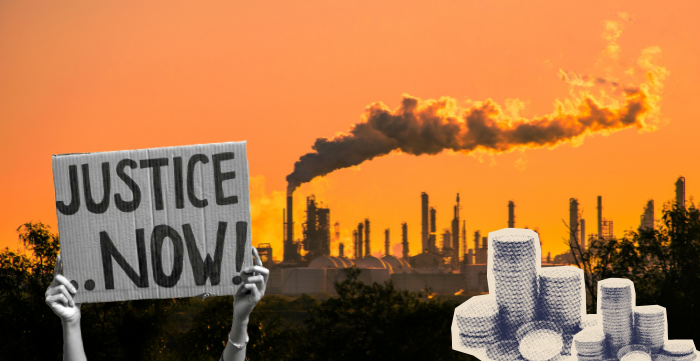
Investor-State Dispute Settlement (ISDS) poses a threat to a just transition away from fossil fuels and to the urgent social and ecological transformation needed for the benefit of people and the planet.
These mechanisms allow foreign investors to sue states before arbitration tribunals outside the national judicial system over laws or public policies that they believe reduce their profits. Neither local businesses, civil society actors nor citizens have access to such a remedy. Even communities directly affected by these investments have no right of recourse!
The mere possibility of a claim influences political decisions. Experts call this “regulatory chill”: a state may refrain from taking action for fear of being sued, even before any proceedings or ruling. Thus, even without a trial or judgment, the mere possibility of bringing a claim against a state poses a major political risk and can lead to “anticipatory obedience”.
Beyond affecting states’ sovereignty and international policy, this also impacts their climate action and cooperation.
An analysis of ten international cases¹ has shown that major petrochemical companies also bring arbitration proceedings against states. Luxembourg is still bound by 60 investment treaties that include investor-State arbitration mechanisms (ISDS). Seventeen have been terminated, but our country continues to sign such treaties despite the risks². An analysis of EU countries indicates that Luxembourg may have signed four new treaties containing such clauses since 2015.
The Fridman case: Luxembourg is also affected
Luxembourg is itself a target. In 2024, Mikhail Fridman initiated arbitration proceedings against the Grand Duchy over the freezing of his assets, seeking 16 billion US dollars, or approximately 14.5 billion euros. Even before the case had reached a judgment, Luxembourg yielded to the pressure and had to persuade the rest of the European Union to remove the oligarch from the sanctions list, which had been adopted unanimously. The oligarch’s lawyers praised Luxembourg’s “positive role”. Although Luxembourg, like the European Union, gave in to Mr Fridman’s pressure, it remains unclear whether he will continue the proceedings.
The arbitration proceedings are not over.
An issue of coherence and justice in North–South relations: the example of Guatemala
Countries in the Global South are particularly exposed to ISDS. In Guatemala, where ASTM has supported peasant and Indigenous communities since 2003 alongside the Comité de Unidad Campesina and the Asociación de Servicios Jurídicos y Sociales (ASERJUS), investors have filed nine treaty-based claims since 2007. They have claimed nearly 1.7 billion US dollars and have already been awarded around 158 million US dollars, excluding interest and costs — and this may not be the end of the story. This amount is more than three times the 2025 budget of Guatemala’s Ministry of Environment and Natural Resources.
Luxembourg is linked to Guatemala through a 2005 bilateral investment treaty with the Belgium–Luxembourg Economic Union, which has been in force since 1 September 2007. The treaty provides for investor-State arbitration and contains a ten-year survival clause. According to the report, it could be terminated from 2027 onwards.
On 2 June 2026, Luxembourg’s Minister for Development Cooperation, Xavier Bettel, and Guatemala’s Minister of Foreign Affairs signed a general cooperation agreement. However, the ISDS system puts at risk the goals of development cooperation based on sustainable development. Policy coherence requires Luxembourg not to fund development, environmental protection and just-transition efforts on the one hand, while maintaining an investment treaty on the other that allows investors to take the partner state to arbitration over measures taken in the public interest.
Our organisations call on the Luxembourg government to support a global coalition against ISDS mechanisms, particularly in the context of COP31. Reports by the United Nations and the Intergovernmental Panel on Climate Change (IPCC) have identified arbitration mechanisms as a major obstacle to fair and effective climate policy.
More specifically, Luxembourg must commit, together with other countries, to:
- Terminate treaties containing ISDS arbitration mechanisms, or renegotiate them with the governments concerned to remove these clauses, in particular by eliminating “sunset clauses” — clauses that keep investor-State arbitration mechanisms in force beyond the duration of the treaty itself.
- Work collectively with other countries to create new opportunities to withdraw from arbitration mechanisms.
- Commit not to sign any new agreement that provides for such a mechanism.
- Include provisions aimed at ending ISDS mechanisms in a future Fossil Fuel Non-Proliferation Treaty.
- Begin negotiations for a multilateral treaty aimed at creating a world without ISDS and establishing, at United Nations level, a fair and transparent jurisdiction for disputes between states and investors.
Mouvement Ecologique and ASTM call on the government to free itself permanently from the ISDS trap, in the interests of the people of Europe and the countries concerned, as well as the climate and international justice.
Click HERE to download the joint press release.
20 October 2026