






Tripartite meeting: Laying the groundwork for a socio-energy transition!
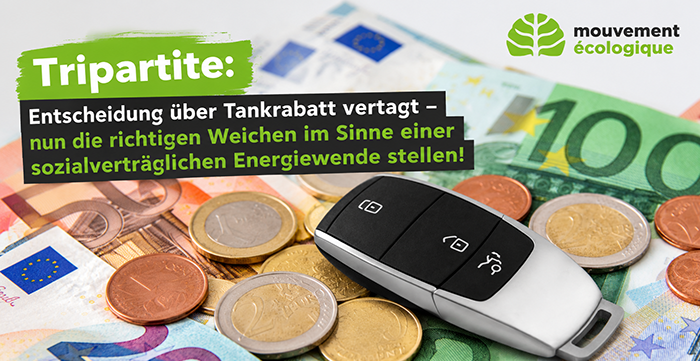
In view of high oil prices, the question of how to deal with the fuel rebate has been on the cards for some time.
Now, however, a decision on the matter is to be taken at the Tripartite meeting under pressure. Why the past few months were not used to the full to discuss possible solutions with all stakeholders – whilst communicating transparently with the public – without time pressure, in a fully objective manner and with concrete calculations, is a mystery to most people.
Yet one thing will be clear by this summer at the latest: the fight against the climate crisis must not be postponed any longer! Luxembourg has committed to reducing its e CO2 emissions by 55 per cent (compared to 2005) by 2030. The state must therefore no longer invest public funds in measures that run counter to this commitment. And this would clearly be the case if the fuel rebate were extended. This is illustrated not least by statistics on the effects of the expiring fuel rebate: sales of both petrol and diesel are once again rising significantly! Anyone wishing to further fuel this upward trend and exacerbate the climate crisis can, of course, stick with the fuel rebate.
It is long overdue for all stakeholders to consider how the necessity of climate protection can be reconciled with social objectives (preventing a loss of purchasing power and excessive inflation – particularly for people on low incomes).
With a view to the next round of tripartite talks, Mouvement Ecologique would like to put forward the following thoughts:
- Targeted social support – less scattergun approach: A fuel rebate is the opposite of a targeted social policy: it also benefits those who have sufficient financial means to pay the real cost of energy! It is actually absurd to use taxpayers’ money to fund their energy consumption.
The primary aim must be to ensure financial compensation, in the face of rising prices, for those households with limited financial resources which, to date, have hardly been included in the energy transition and are suffering particularly from rising prices. Increasing the ‘crédit d’impôt’ could be a perfectly sensible tool for this. This is because this compensation exclusively benefits low-income households, including cross-border commuters.
The focus should be on these households. Decisions should be based on modelling by the STATEC authority, which is not currently available, however! - Why the focus on fuels – petrol and diesel? Surely, apart from the energy sector, there are other sectors where a reduction in excise duty would be possible without negative environmental impacts … This should be discussed openly.
However, if we stick to the energy sector, Luxembourg households spend roughly the same amount of money on the energy required for housing as they do on fuel. This means that providing relief for consumers in the energy sector – to influence purchasing power and inflation – would make sense in the ‘housing’ sector.
After all, in the context of the electrification of our energy supply, it would be more understandable – given the current pressure – to provide short-term energy support in the electricity sector rather than on fuel prices. Here too, the question arises: why are there no calculations available from STATEC (at least publicly) that would examine the impact of measures in this area?
Whether, in addition to energy support for electricity, further support would still be required for gas or heating oil to tackle the goal of curbing inflation would need to be analysed. After all, on the one hand, we must succeed in phasing out gas, not to mention heating oil. In this respect, energy support for these energy sources would not be permissible.
However, to keep inflation under control, one could argue that many residents were not yet willing or able to switch to alternatives – such as heat pumps. The expansion of public district heating networks – on which some people rely to escape the ‘gas trap’ – is also still in its infancy in Luxembourg. In this respect, there would at least be understandable arguments if the state were to intervene here, even if this would represent a further investment in fossil fuels and would therefore be problematic.
Such a measure could, at best, be regarded as legitimate only if, at the same time, far more decisive action was taken on legislation and support for phasing out gas and heating oil – in other words, a genuine heating transition. In other words: putting on the table the short-term introduction of pre-financing for heat pumps as well as social leasing schemes for heat pumps, the expansion of district heating networks (clarifying the issues of funding, the responsibilities of the stakeholders and the legal basis), and solutions for the situation of tenants and blocks of flats…
Ultimately, an objective discussion is only possible on the basis of facts: STATEC would need to disclose what impact reductions in electricity prices for end consumers would have on inflation – and to what extent additional measures in the gas and heating oil sectors would be relevant.
- If the fuel rebate is continued: could security of supply be called into question? In addition to climate policy considerations, the Ministry of Economic Affairs put forward a further argument against retaining the fuel rebate during the tripartite discussions. At a time when fossil fuels are in short supply, it is precisely the price that is supposed to reflect this scarcity. If the state intervenes artificially here, it creates consumer behavior that does not take account of the true value of a commodity. The reduced prices are therefore likely to lead to an increase in fuel sales (both domestically and through ‘fuel tourism’), as has indeed been the case in recent months. This could potentially exacerbate supply problems. Is the state the driving force behind supply problems?
- Why not strengthen the state’s role in expanding the electricity grids and thus invest in public infrastructure – rather than merely subsidising consumption? To date, the state has covered part of the grid charges – that is, the portion of the electricity price attributable to the use of the grid. In this way, it subsidises electricity consumption. An alternative would be for the state, rather than covering these costs, to (co-)finance the expansion of the grid directly – thereby reducing the financing costs for the grid operator. These costs are also reflected in the electricity price, so this state investment in the grid would also have the effect of lowering the price for the end consumer. In this way, the state would also make an important contribution to making the electricity grid ‘fit’ for greater electrification across all sectors, which is essential (due to the expansion of heat pumps, e-mobility, the management of renewable energies, etc.). Put simply: instead of financing consumption – finance the infrastructure. This would not only reduce grid charges but also create social added value in relation to the necessary energy transition.
- Making fact-based decisions: The documents for the tripartite meeting on 20 October, which were made available to everyone, were completely lacking in calculations and modelling of the proposed measures. Questions such as:
* How significant are the expected fuel price rises in terms of the loss of purchasing power / the index debate?
* Which income quintiles would be affected by the price rises, and to what extent? What would the consequences be for the commercial sector?
* What impact might the various solutions under discussion (increase in the tax credit, fuel rebate, reduction in energy prices, etc.) be expected to have in terms of inflation?
* Which form might targeted social compensation take?
Given the significance of this issue and the fact that the STATEC calculations are not yet available, it would be downright negligent to make decisions in a week’s time without such facts being available. This would hardly boost confidence in the way policy is made in Luxembourg.
Furthermore, on 4 November, STATEC will present definitive inflation forecasts (as well as updated calculations for the next automatic wage indexations). Why should a tripartite committee have to decide a few days earlier without these crucial facts? Is the time pressure so great that we cannot wait these few days?
Conclusion
In the view of the Mouvement Ecologique, particularly in the wake of this summer, the issue of climate protection must not be sidelined once again and subordinated to the – legitimate – demand to maintain purchasing power and address the issue of inflation. Continuing the fuel rebate would constitute a serious mistake in this regard.
It is up to the government (and the social partners) to demonstrate that, in the forthcoming short-term decisions, they will succeed in addressing the relevant issues for the future – that is, the socio-ecological transition (climate protection and, in particular, ensuring that people with fewer financial resources are included) – without pitting climate protection against these other issues.
In the medium to long term, however, it is essential to hold a far more structured, fact-based discussion on how the urgently needed energy transition, price transparency, social equity and inflation can truly be reconciled. It would be a grave mistake to wait for the next tripartite discussion until a fundamental debate has taken place.
Such an (exit) strategy is an environmental and social one, but it is also a matter of the national budget: surely no one seriously believes that energy prices – particularly for fossil fuels – will fall significantly again in the coming years. The state will not be able to afford to ‘manipulate’ the real costs of fossil fuels for years on end and continue to invest hundreds of millions of euros in a fuel rebate for years to come.
Mouvement Ecologique asbl
23 October 2026
You can find the statement as a PDF HERE.