








Commitment yields a milestone victory: EFSA confirms contamination – the daily intake limit for TFA has been lowered
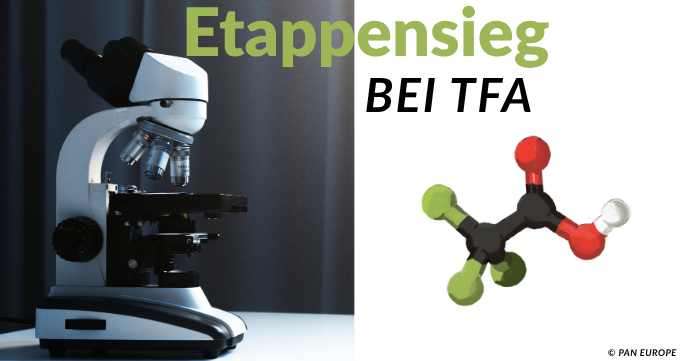
Trifluoroacetic acid (TFA) is a PFAS breakdown product produced in vast quantities by pesticides, refrigerants and other industrial chemicals, and which is steadily accumulating in drinking water, soil and even in foodstuffs such as cereals and wine (see studies by PAN Europe and Mouvement Ecologique from 2024 and 2025).
Environmental organisations, such as Mouvement Ecologique, have stepped up pressure in recent years to ensure that the negative effects of TFA are investigated more thoroughly and that limit values (including intake via food and concentrations in water) are adjusted.
And they have achieved a significant success!
On 22 July 2026, the European Food Safety Authority (EFSA) confirmed what the environmental organisations had been warning about: TFA is significantly more toxic than previously assumed by the authorities. The Acceptable Daily Intake (ADI) – that is, the amount a person can consume daily throughout their entire life without any health risk – has now been reduced by 72 per cent. Proven health risks include, amongst other things, thyroid disorders with consequences for foetal brain development, liver damage and reduced sperm quality. This follows, amongst other things, from the classification of TFA as toxic to reproduction by the European Chemicals Agency (ECHA) in June.
This is an important milestone – yet even the new limits are considered too lenient by experts, as potential cancer risks and effects on brain development have not yet been investigated at all.
One thing is clear: remediating water and soil alone is not enough (and is only possible to a limited extent) – pollution levels will only fall if PFAS pesticides, F-gases and other sources of TFA are banned at source. And in this regard, both the EU and Luxembourg must take far more decisive action.
27.08.26