






11-Point Plan for the Urgently Needed Heat Transition in Luxembourg (with video in Luxembourgish)
The heat transition is one of the central energy and climate policy challenges for Luxembourg. While the electricity sector has already made significant progress in renewable energy, the heating sector remains heavily dependent on fossil gas and heating oil. More than 80% of household energy consumption is used for heating and hot water. Without a fundamental transformation of heat supply, national and European climate targets cannot be achieved. At the same time, the heat transition is a social, geopolitical and economic necessity: it reduces dependence on energy imports, strengthens security of supply, stabilises long-term prices (both for industry and private households, which become less exposed to price increases) and opens opportunities for innovation and investment.
However, there are currently no clear political priorities, binding timelines or a coherent legal framework. This uncertainty blocks municipalities, energy providers and investors. Luxembourg therefore urgently needs a national heat strategy with a clear roadmap, to be presented by the end of 2026 and translated into a Heat Act at the beginning of 2027. This law must define responsibilities, financing models, regulatory conditions and binding phase-out dates for fossil fuels.
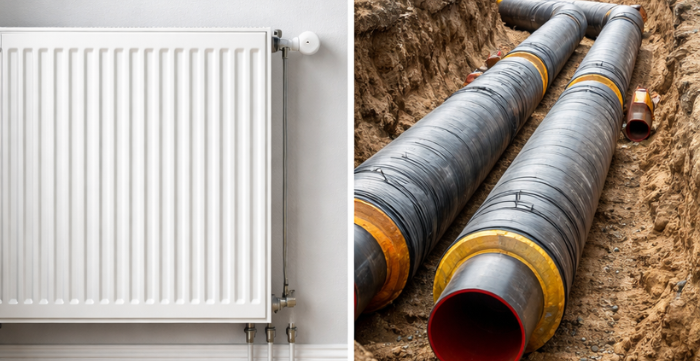
A central element is the development of a national heat and cold plan in line with EU requirements. This plan must systematically analyse how heat demand evolves (sink), which renewable sources are available (source), and how energy can be efficiently distributed (networks, individual solutions). Technical, economic and social aspects must be integrated. In parallel, major investments in infrastructure are required, especially in grid heating. This demands identifying and mobilising financing instruments, socially fair cost distribution and regulatory certainty.
District heating will play a key role in densely populated areas. Since they represent natural monopolies, strong regulation is necessary, particularly through an expanded role for the Institut luxembourgeois de régulation (ILR). At the same time, ownership and operating structures must be clarified – from municipal models to a potential national heat company.
A significant efficiency potential lies in the mandatory use of industrial waste heat. Likewise, existing heating networks must be gradually decarbonised.
At the municipal level, clear criteria for mandatory heat planning, stronger state support, standardised guidelines and intermunicipal cooperation are needed.
Public acceptance is crucial for success. Transparent communication, social compensation measures, clear support instruments and binding transition timelines are essential.
The heat transition must be predictable, socially just, and implemented with political determination.
I: Addressing challenges at the national level
Unclarified national conditions lead to blockages – they must be resolved in the interest of all stakeholders
PLANNING LEVEL
- Develop a national heat and cold plan as a strategic guiding framework – also to comply with EU requirements
LEGAL AND FINANCIAL LEVEL
- Present without delay a law on heat planning and on the decarbonisation of heating networks
- Define financing and regulatory rules for heat and cold supply networks
- Ensure the economic viability of heating networks
CLARIFY RESPONSIBILITIES – THE ROLE OF THE DIFFERENT ACTORS
- Expand the role of the Institut luxembourgeois de régulation
- Clarify responsibilities for the implementation of heat and cold supply networks
KEY ISSUES TO BE RESOLVED
- Obligation to use waste heat from industry and commercial sectors
- Define strategies to decarbonise existing heating networks
II: Addressing challenges at the municipal level
- Establish requirements for carrying out heat planning
- Support municipalities in developing and implementing heat plans
- Build acceptance through good planning and effective communication
27.02.26