







Stimulating conference on the contamination of food by forever chemicals (PFAS)
“The bathtub is overflowing, we must turn off the PFAS tap!”
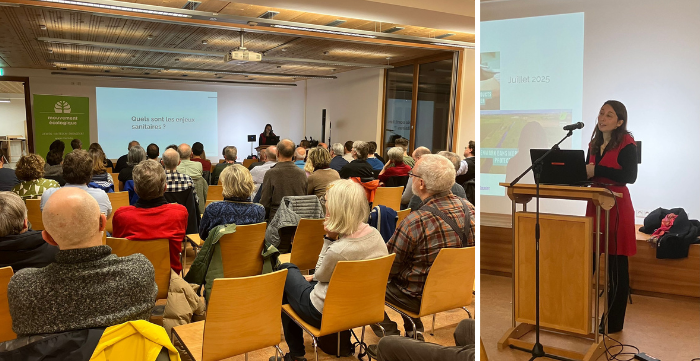
These are the words of Kildine Le Proux de La Rivière, chemist at the French NGO Générations futures. With her lecture “Alarming contamination of food by the forever chemical PFAS”, she attracted around 70 people to the Oekozenter Pfaffendall on 13 November 2025 at the invitation of the Mouvement Ecologique.
The audience was very diverse, ranging from interested (or concerned) citizens to civil servants, politicians and scientists. The evening was marked by lively discussion and keen interest.
The speaker explained the difficult topic of PFAS in an understandable way, using many illustrative examples. She began by explaining what PFAS chemicals actually are. They are man-made per- and polyfluorinated alkyl substances which, due to their chemical structure, are extremely stable and therefore persistent in the environment, which is why they are considered “forever chemicals”.
After these explanations, she went on to discuss why these substances pose a major challenge to the environment and health. She particularly emphasised their persistence: PFAS hardly degrade, accumulate in soil, water and organisms, and thus also enter the food chain.
She illustrated the latter with analyses carried out by Mouvement Ecologique in 2024 and 2025 in collaboration with the Pesticide Action Network Europe: the smallest PFAS molecule, TFA, has already contaminated our drinking water on a large scale, is even detectable in bottled mineral water and appears to accumulate in plants (cf. analysis of TFA in wine).
The speaker criticised the fact that many PFAS are not yet sufficiently regulated and that the existing thresholds for weekly intake can be exceeded very quickly. A particularly striking example: according to analyses by Générations futures, a child could reach the maximum weekly intake for certain PFAS by consuming a single egg. One egg! This highlights the urgent need for regular analyses and stricter limits to protect health, especially that of children.
In the last part, she discussed the ongoing regulatory processes at EU level. She emphasised that there are already positive examples within the EU: individual countries, such as Denmark and France, have already banned certain products containing PFAS (clothing, cosmetics, pesticides, etc.). She thus made it clear that Luxembourg and other countries also have scope for action to regulate at national level – they do not have to hide behind the pretext of waiting for EU regulations, but could proactively protect health and the environment!
One thing was clear after the presentation: as consumers, we can protect ourselves from exposure to PFAS through small gestures, such as consuming organic food (see further tips from BUND on PFAS-free cooking and cosmetics) – but the real change needed will come through regulation or a ban on these substances. This is because “the environment is already overflowing” with PFAS and only stopping any further introduction will help to curb the problem.
The presentation was recorded and is available here on the website (in French). The presentation slides can also be downloaded from the downloads section at the top right.