







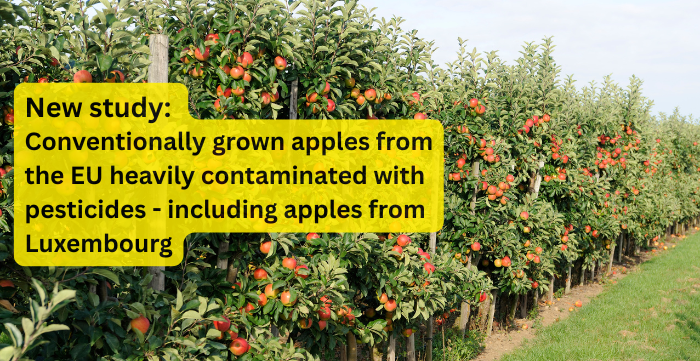
New analyses show: Conventional apples – including those from Luxembourg – are contaminated with multiple pesticides and are not suitable for consumption by young children!
Much more consistent action by the government is needed to protect the population and nature from pesticides!
How many more harmful toxins do we have to consume every day through our food before the government finally takes action? Given this lack of action, how is it even possible to protect your children and yourself from the harmful side effects of pesticides?
These and similar distressing questions arise when looking at the alarming results of a new Europe-wide study by the Pesticide Action Network Europe (PAN Europe).
The object of the study was the symbol of healthy eating par excellence: the apple. What’s more, it was locally grown and bought ‘next door’ – so you’d think you’d be on the winning side when it comes to health. Right?
Unfortunately, the study refutes this assumption – in a dramatic way: 90% of conventional apples from Europe should not be eaten by children under the age of three according to EU regulations due to the pesticide residues measured. The residues found in this study were a staggering 7 to 112 times higher than the legal limit for baby food – something most parents are certainly unaware of.
The Mouvement Ecologique contributed three samples of conventionally produced apples from Luxembourg to this study – unfortunately, these stand out particularly negatively in the European average, as they have above-average levels of contamination with a cocktail of different pollutants!
This analysis is one of a whole series that has been published in recent years:
- Detection of pesticide residues in the hair of children in Luxembourg: the hair samples of ALL children were contaminated (analysis by LIST on behalf of the Ministry of Health in 2022);
- Dust analyses in 12 different households in Luxembourg: All analyses showed high levels of pesticide active ingredients, regardless of location (analyses commissioned by Mouvement Ecologique in December 2022);
- Regular official food sampling by the Luxembourg food authority ALVA;
- Several analyses over the past two years as part of an EU-wide campaign by PAN-Europe to record exposure to the persistent chemical TFA, which largely originates from agricultural pesticides: groundwater and surface water, tap water, mineral water, and in the food chain in flour, bread, pasta and wine.
It is not as if these highly alarming analyses have been completely without consequences.
On the one hand, public awareness of these problems has certainly increased. On the other hand, various authorities have also taken action; for example, the Water Management Authority has carried out analyses and organized a technical seminar.
However, there is still a lack of concrete measures to protect human health and the environment from these harmful and destructive pollutants, as well as concrete initiatives to provide farmers with more advice on alternatives to harmful pesticides and to make these alternatives more widely available – even though alternatives do exist.
On the contrary:
At EU level, attempts are even being made to roll back environmental and health protection through deregulation by means of the so-called Omnibus packages (see explanations at the end of the statements). It is not known what position Luxembourg’s representatives at EU level are taking on this issue: are they on the side of those who want to deregulate, or do they represent the interests of consumers and the environment? In several parliamentary questions, the Ministries of Agriculture, Environment and Health failed to provide an answer to this important question.
In December, the Ministry of Agriculture presented a unambitious and largely empty Luxembourg organic action plan, which should be a key instrument for reducing pesticide use. This attitude and the failure of the Ministries of Health, Agriculture and Environment to take action to reduce pesticide use and its negative consequences for the environment, biodiversity and health through the consistent expansion of organic farming is alarming.
Enough is enough, we must put an end to putting human and natural health at risk! We have a right to healthy food that is not contaminated with a cocktail of toxic chemicals.
The Mouvement Ecologique urges the Luxembourg government to finally tackle the challenge of converting Luxembourg to agriculture that is compatible with health and nature and produces food without harmful toxins!
This is a challenge for the entire government and, above all, for Agriculture Minister Martine Hansen, Health Minister Martine Deprez and Environment Minister Serge Wilmes.
The new study on pesticide contamination in apples, which in a sense is now the last straw and the specific demands of the Mouvement Ecologique, are presented in more detail below.
A version of the short film with English subtitles will be available shortly on our social media channels.
Translated by deepl.com
January 2026