






Have you seen any feeding stations for wildlife? Please let us know.
Those responsible at Mouvement Ecologique, who are in charge of drafting the statements on hunting, as well as the board of directors of Mouvement Ecologique, are well aware of the fact that some people find it difficult to accept that an environmental organisation is campaigning for more hunting. The view that ‘nature regulates itself and humans should not interfere’ is, of course, close to everyone’s heart.
The forest is suffering considerably from the climate crisis, and everything must be done to mitigate it as far as possible. However, certain changes, e.g. in terms of precipitation, are taking place and will intensify.
Periods of drought, etc., are causing considerable damage to the forest.
However, the fact is that even without human intervention, i.e. hunting, our forests will no longer be able to fulfil their diverse ecosystem services in the future because the game population is too high. Here, too, the climate crisis is already playing a major role: the formerly colder
winters with long periods of frost often led to a significant reduction in game populations, especially wild boar. There is no denying that traditional conservation hunting with ‘emergency feeding’ in winter, the protection of female animals and the (sometimes illegal) introduction of foreign game species (such as mouflon and fallow deer) also contribute to the high game density. However, modern agriculture, with its abundant food supply and protection in large maize fields, also contributes to an increase in game populations.
The Mouvement Ecologique has therefore been campaigning for years for a ban on feeding. This has been successful. In the latest reform of the hunting law, feeding was banned and made a punishable offence.
Currently, only ‘baiting’, i.e. attracting game for hunting, is permitted. The Mouvement Ecologique considers this practice acceptable, as it is indispensable for ensuring that hunting is as undisturbed as possible.
So what does proper baiting look like and how does it differ from feeding?
The baiting of wild boars is normally hardly noticeable to walkers, as in this case it involves a maximum of 1 litre of grain/maize kernels covered with wood/stones so that it is not accessible to other species of game. The
baiting of wild boars is permitted all year round.
Baiting ruminants (deer, roe deer, fallow deer/mouflon) can be done with hay, carrots, beets, apples, other fruit, and some oats in quantities of up to 5 litres, but only during the deer hunting season (1 May to 31 January).
All processed food such as bread and similar items are prohibited. Baiting must be reported to the ANF and no more than one baiting site for wild boar and one for ruminants per 50 hectares (or part thereof) of forest area may be operated.
Anything other than the options described above is, in principle, feeding!
For some time, the feeding ban was respected, but the Mouvement Ecologique has now noticed that feeding is once again becoming commonplace. This is completely absurd: the aim is to shoot more game, but hunters are feeding animals and contributing to an increase in populations
Have you seen any feeding stations? Report them to us (meco@oeko.lu)! We will forward your report to the nature conservation authorities so that action can be taken.
What we need from you:
– the coordinates of where you saw the food source;
– the date when you noticed it;
– a photo.
We will forward this to the ANF (without mentioning your name). You are also welcome to let us know if you are unsure whether it is a feeding station or feeding.
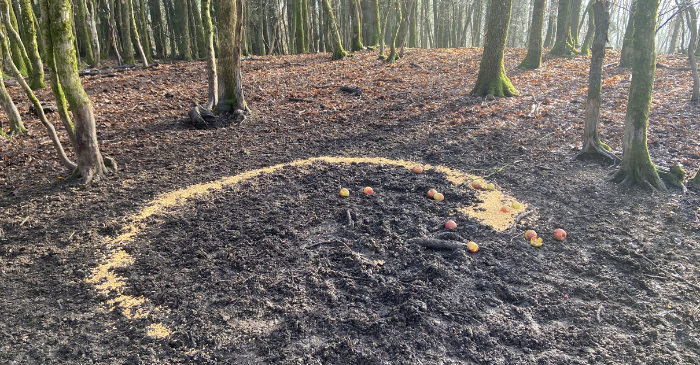
This is clearly feeding.
26.02.26