








Forever chemicals in the food chain: Cereals are also contaminated
High levels of the forever chemical TFA found in everyday cereal products across Europe, including Luxembourg
New analyses reveal high levels of the toxicologically harmful “forever chemical” trifluoroacetic acid (TFA) in everyday cereal products across Europe. These analyses were carried out as part of a Europe-wide campaign by Pesticide Action Network (PAN-Europe), in which Mouvement Ecologique actively participated as a member. The average concentration across Europe is 100 times higher than the levels already detected in drinking water as part of the campaign. Luxembourg products are also affected.
The report shows how our diet is a significant route of exposure to TFA. Due to decades of political and scientific ignorance of this molecule, there are currently no adequate limits in place to protect human health. As TFA is suspected of being harmful to health and of accumulating in the environment, PAN Europe and its member organisations are calling on decision-makers to immediately set limit values in line with the precautionary principle and, above all, to take far-reaching measures to reduce TFA exposure! Any further avoidable release of forever chemicals into the environment and food chain must be stopped now.
You can now read the press release here as well as in the downloads. The downloads also include the original PAN Europe report and a Questions & Answers document (both in English). In addition, we have made a small collection of links available under “PFAS alternatives” to help you avoid PFAS products in everyday life.
Cereal products from all over Europe contaminated – including Luxembourg
In the new study by PAN Europe, in which Mouvement Ecologique participated, 66 cereal products from conventional agriculture in 16 European countries were tested for the persistent chemical TFA, including breakfast cereals, well-known sweets, pasta, croissants, wholemeal and white bread, and flour.
As there are currently no official food analyses that systematically examine TFAs, this study is the first of its kind at EU level. It follows on from reports by PAN Europe in recent months that have detected TFAs in surface water, groundwater, drinking water, mineral water and wine.
As cereal products are a central component of the diet, it is important to investigate the extent of TFA contamination in these everyday foods. This is a prerequisite for assessing whether the measured contamination levels pose potential health risks or not.
Mouvement Ecologique contributed products from Luxembourg to this study. Only samples that were proven to be made from grain grown in Luxembourg according to packaging or information provided by sellers were taken (in samples from other EU countries, the origin of the grain was not taken into account to the same extent; popular/typical grain products available in supermarkets were examined).
TFA – alarmingly high levels of this harmful molecule in the food chain
TFA is considered the smallest molecule in the large group of so-called “forever chemicals” (PFAS chemicals) and is found in our environment primarily as a degradation product of PFAS pesticides and F-gases (used in air conditioning and refrigeration systems). TFA is extremely stable, mobile and harmful to reproduction. Scientific studies also show links to reduced sperm quality, hormonal disorders and negative effects on, for example, the thyroid, liver and immune system. As TFA is water-soluble, it accumulates in water and soil, where it is absorbed by plants, among other things.
The contamination measured as part of the campaign is significant across Europe: TFA was detected in bread, pasta, breakfast cereals, flour, pasta and biscuits. 81.8% of the cereal products randomly tested in 16 countries (54 out of 66 samples) contained TFA concentrations above 10 µg/kg (Figure 1). The values range (from a detection value of over 10 µg/kg) from 13 µg/kg to 360 µg/kg (breakfast cereals from Ireland). The average contamination level is 78.9 µg/kg. This value should actually be zero, as forever chemicals have no place in food (or the environment).
It is alarming that these TFA levels in cereal products are 102 times higher than the average values found in drinking water in an earlier PAN Europe study.
The Luxembourg samples ranged from 39 μg/kg (spelt flour) to 120 μg/kg (wheat flour) – no TFA was detected in rye bread and oat flakes. Other products tested included white wheat bread and wheat pasta. The two breads came from two different suppliers (one of which was a small bakery), while all other products came from the same manufacturer.Studies suggest that wheat in particular can absorb TFA efficiently, which could explain the high TFA levels in certain products. Further scientific analysis is needed here.
|
The results clearly show that our food chain is riddled with TFAs and that urgent action is therefore needed. What the results cannot do (due to the heterogeneous selection of products – from pure flour to further processed products with more ingredients than just grain – a varying number of samples and the uncertainty that exists in some cases about the origin of the grain) is a comparison between products or countries.
This is also not the aim of the PAN Europe study – it simply wants to highlight the extent of TFA contamination, the main routes of exposure and the need to curb it as quickly as possible through precautionary limits and regulations.
The 66 samples are a first step towards understanding TFA contamination in cereal products. The geographical diversity, the range of cereal products analysed and the consistency of the results – widespread contamination, elevated average concentrations and frequent detections in different regions – strongly suggest that this is a structural EU-wide problem. |
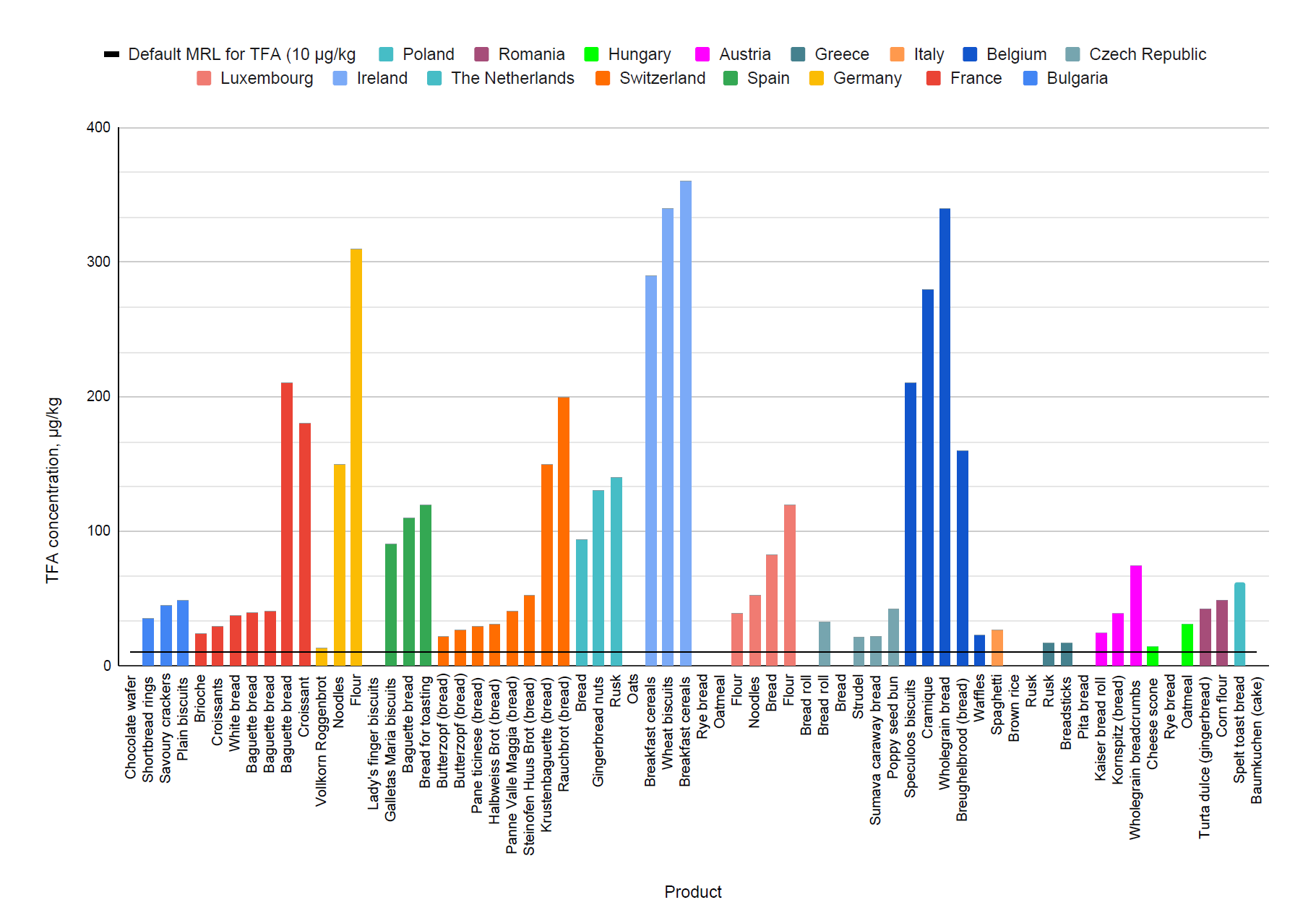
Figure1 : TFA levels in cereal products from 16 European countries. The cereals do not always originate from the respective countries, as the origin was not always indicated on the product. The Luxembourg products (circled in red) all originate from cereals grown in Luxembourg. The line indicates the default maximum residue level (MRL) of 10 µg/kg, in accordance with the Pesticides Regulation . This MRL is considered a “safety net” standard limit for pesticide residues that are harmful to health if no specific value has yet been defined for a substance such as TFA. To ensure that health is not compromised, residues of any substances should be BELOW this value. However, in the study on TFA in cereal products, 80% of the samples exceed this value, which is cause for concern.
It is absolutely necessary to set limit values for TFA from a health perspective.
The study shows that people consume a relevant amount of TFA (trifluoroacetic acid) daily through cereal-based foods. There is scientific consensus that TFA is toxicologically questionable – this has been confirmed in animal experiments.
However, as the health risks posed by TFA have not yet been sufficiently investigated scientifically, opinions still differ as to the level of exposure that poses a direct health risk. Further investigations are therefore also being carried out at EU level in order to be able to make more reliable statements.
As a reslt, the values currently considered acceptable by the European Food Safety Authority (EFSA) for TFA as a potentially harmful substance without risk to health vary widely between individual countries. The following table shows these so-called ADI values – Acceptable Daily Intake, i.e. safe daily values that regulate how much a person can consume per day – (Fig. 2)2.
PAN-Europe believes that there must be zero tolerance for endocrine disruptors such as TFAs. However, as TFAs are now widespread and cannot be removed from the environment, an ADI of 1.8 µg/kg is recommended. This ADI is rightly very cautious and takes into account any scientific uncertainties regarding the toxicology of TFA that currently exist. As the graph shows, it is even higher than the value applicable in the Netherlands.
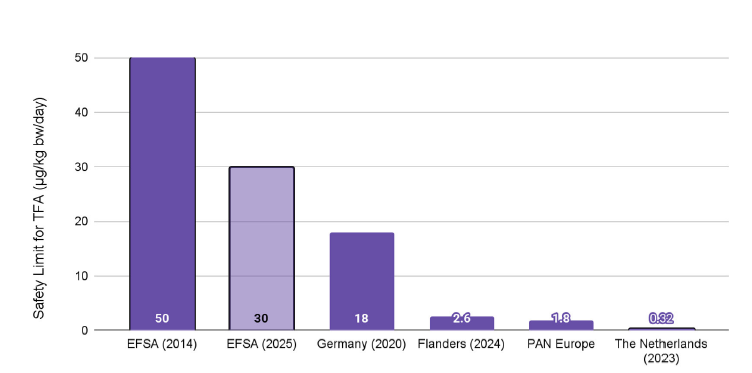
Figure 2: The health-based safety limits (ADI, Acceptable Daily Intake) for TFA vary widely in some cases. PAN Europe calls for a low ADI that takes into account the existing toxicological uncertainties regarding TFA in accordance with the precautionary principle.
According to PAN Europe, the maximum permissible daily intake of TFA is exceeded in children.
However, the question of how much TFA a person consumes through cereals is also decisive in determining how problematic the average TFA exposure in cereal products (78.9 µg/kg) measured in the study is for human health.
To assess this, PAN Europe took a closer look at the daily TFA intake for two consumer groups based on its ADI (acceptable daily intake, i.e. the maximum amount of TFA that should be consumed): adults (18–65 years) and children (3–9 years).
The European Food Safety Authority (EFSA) provides data on how much each consumer group consumes on average from this food product each day.
Based on this data and the levels detected, PAN Europe concluded that children consume an average of 0.64 µg TFA per kg of body weight per day through cereal products. This corresponds to 35% of the acceptable daily intake (ADI) of 1.8 proposed by PAN Europe. In “unfavourable” cases, where children eat more cereals or these are more heavily contaminated, intake may exceed 150% of the ADI.
Adults consume an average of 0.25 µg TFA per kg of body weight per day. This corresponds to 14% of the proposed ADI. In “unfavourable” cases, the value can reach almost 70% of the ADI.PAN Europe has also recalculated this based on the specific products examined in the study: After a breakfast consisting of breakfast cereals from Ireland, a 10 o’clock snack of two slices of Belgian bread, a lunch of German pasta, a slice of “cramique” from Belgium in the afternoon and Italian pasta in the evening, a child reaches 186% and an adult 70% of PAN Europe’s ADI! It is clear that not every day looks like this – but the fact is that cereal products are the basis of our diet and the maximum values are quickly reached. And this does not even include all other foods as potential sources of TFA.
Although these results for cereal-based products are alarming in themselves, TFA has also been detected in a variety of other food components, including vegetables, fruit, culinary herbs and plant-based beverages such as fruit juices, tea, infusions, wine and beer, as well as in drinking water (tap and mineral water).
In addition, human exposure to TFAs through rain, air and dust has also been documented. The full extent of TFA exposure among EU citizens is currently unknown. To the best of PAN Europe’s knowledge, no attempt has yet been made to calculate daily exposure from the numerous routes and sources of TFA intake.
The present findings, in line with previous studies, have important implications for the establishment of a protective “acceptable” daily intake and for the regulation of TFA precursors.
TFA must be regulated under the Pesticides Regulation
TFA enters the environment in large quantities from F-gases and pesticides. F-gases are mainly found in air conditioning and refrigeration systems, and when they enter the air, they are converted by sunlight and air reactions into the very long-lived substance TFA. While this returns to the earth diffusely via rain or air, pesticides produce degradation products such as TFA immediately after application, which enter the soil and agricultural ecosystems directly.
According to EU Pesticide Regulation (EC) 1107/2009, active substances with potentially harmful properties are subject to strict requirements: They must not be detectable in food, or their maximum residue level must be set at the default maximum residue level (default MRL) of 0.01 mg/kg.
Ban pesticides containing PFAS and switch to sustainable and organic farming
Based on all the above considerations, from the point of view of protection against TFA, all pesticides that contain PFAS chemicals as active ingredients and that break down into TFA as a degradation product should be banned.
In this context, Mouvement Ecologique expressly welcomes the fact that the TFA-releasing pesticide active ingredient flufanecet has been banned in Luxembourg. However, other PFAS pesticides, such as flutolanil, can still be used.
For this reason, Mouvement Ecologique calls on the Ministry of Agriculture, together with the Ministry of Health and the Ministry of the Environment, to set the right course for promoting sustainable agriculture in which farmers are not dependent on PFAS-containing pesticides or other synthetic chemical pesticides – also in view of the further negative effects on nature and the environment.
A ban on PFAS pesticides is feasible: numerous European farmers are already working successfully without PFAS pesticides, demonstrating that productive agriculture is possible without these substances. Organic farming, which completely avoids these products, is considered the safest alternative, but integrated plant protection measures also offer opportunities. Organic farming must finally be consistently promoted in Luxembourg as well.
In addition, a ban at EU level is urgently needed: the continued authorisation of the 31 PFAS pesticides still on the market contravenes the EU Pesticides Regulation, which states that an active substance may not be authorised if its toxicologically relevant metabolites exceed the limit value of 0.1 µg/L in groundwater. The European Commission has recognised TFA as a relevant metabolite of PFAS pesticides in groundwater – this limit is often significantly exceeded throughout the EU. Member States and the Commission are therefore obliged to ban PFAS pesticides, as Denmark has already done.
Conclusion: No more inaction – regulation and control are now required!
Food is a more significant source of TFA exposure than drinking water, as it is much more heavily contaminated and the concentrations in many samples exceed both precautionary maximum levels (MRLs) and estimated safe intake levels for children. The differences between samples and cereal types highlight that there are still gaps in our understanding of which foods pose the greatest risk, but the overall picture points to a persistent and growing public health problem.
The ubiquity of TFAs is directly linked to regulatory inaction on PFAS-containing pesticides and other TFA-forming substances. Decades of approval and use of these chemicals have led to the contamination of soil, crops and staple foods. Research also shows strong correlations between TFA residues and PFAS pesticide residues in plant-based foods, confirming that regulatory decisions have direct real-world impacts on human exposure.
Given its extreme persistence, rising concentrations and multiple routes of exposure, TFA poses a clear and growing health threat. Immediate regulatory action is needed to prevent further accumulation of this harmful chemical in Europe’s food and environment.
PAN Europe and Mouvement Ecologique are therefore calling for the following urgent measures at national and EU level:
– a ban on PFAS pesticides,
– the reduction of the acceptable daily intake (ADI) for TFAs by the European Food Safety Authority (EFSA) to take account of current toxicological uncertainties, as a safeguard for vulnerable individuals such as children, in accordance with the precautionary principle,
– Systematic monitoring of TFAs in food by EFSA and the national food authority ALVA.
– Restricting F-gases through the European REACH Regulation.
– Support for farmers in the transition to crop cultivation methods without chemically synthetic toxins and, more generally, to organic farming.
Read more:
- Report by PAN Europe: Unseen and Unregulated – TFA, the “forever chemical” in Europe’s cereals
- Briefing by PAN Europe on PFAS pesticides and TFA
- List of approved PFAS pesticides
Mouvement Ecologique – Luxembourg, 4 December 2025
_________________________________________
Footnotes:
1: PAN Europe’s investigation TFA: The Forever Chemical in the Water We Drink (2024) found an average TFA concentration of 740 ng/L in 36 tap water samples collected across 11 EU countries.
2: The values set between 0.32 and 50 µg/kg body weight per day reflect the extent to which the respective scientific authorities have taken into account the available data and existing gaps in knowledge on the health effects of TFA – however, this is not always entirely comprehensible or sufficiently based on scientifically independent studies (e.g. the EFSA’s 2014 ADI was taken from a position paper by Bayer).
Key findings and conclusions of the PAN Europe study at a glance:
Contamination with TFA is widespread, particularly in wheat products, indicating a systematic presence in the European food supply. The differences between samples and cereal types highlight that there are still gaps in our understanding of which foods pose the greatest risk, but the overall picture points to a persistent and growing public health problem. Decision-makers are now called upon to take adequate precautions, including banning PFAS pesticides, strictly regulating and largely banning the use of F-gases, setting precautionary limits and monitoring food. Support for farmers to engage in sustainable and organic farming is also essential. The Mouvement Ecologique calls on the Ministry of Agriculture and the Ministry of Health and Environment to take action now and to advocate for these changes at EU level! |