








Epsiode 14: Eagle Owl
With the new ” Lend an ear to nature” campaign, the Mouvement Ecologique wants to draw attention to these often-threatened species and their habitats – and combine it with a guessing quiz on the noise of the animal in question.
A total of two short videos on a species of animal from our localities and landscapes will be published each month from the end of April until October.
Guess with us – which animal is making that sound? and win a Naturata voucher worth €50 per spot!


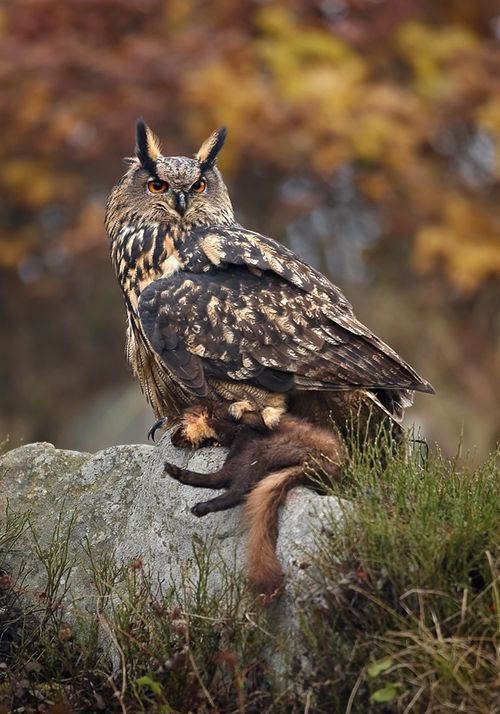
(C) Martin Mecnarowski
Did you recognise the eagle owl in the clip?
It shouldn’t be too difficult to identify the caller – after all, it calls its own name repeatedly every few seconds. We are talking about the eagle owl, the largest species of owl in our latitudes. The English name ‘eagle owl’ refers to its impressive size – its wings have a wingspan of 180 cm!
The calls of the eagle owl can now be heard in autumn (September to November) and spring (January to April). Both periods are considered the eagle owl’s mating season. The males call to mark their territory and attract females. During this time, the male’s calls can often be heard long before dusk and up to 5 kilometres away, although this is difficult to hear in urban or noisy landscapes.
Way of life and requirements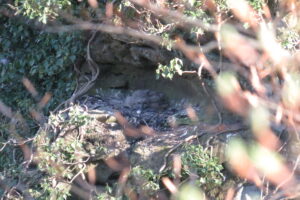
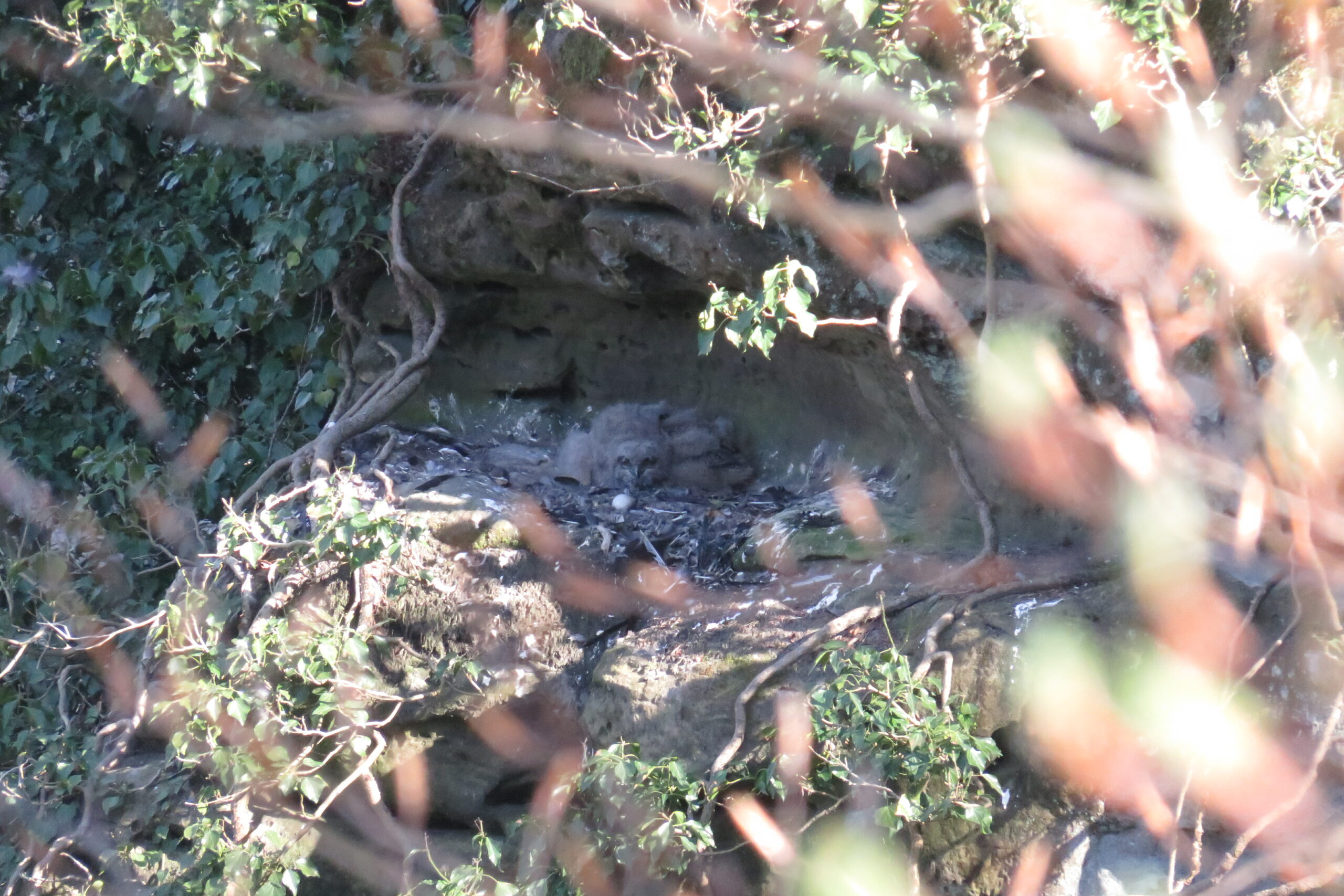
The eagle owl is the largest native owl and, thanks to conservation measures, is no longer a rare forest bird. During the day, it dozes hidden in a rock niche or in the cover of tree tops, and at dusk and especially at night, the eagle owl flies out to hunt.
The eagle owl itself has no natural predators; it is at the top of the food chain. It is not picky about its prey: mice, rats, amphibians, pigeons, buzzards and even hedgehogs are all on its menu. The way it hunts is just as varied, sometimes flying, sometimes hopping on the ground. However, the amount of food must be right, which is why it can now be found not only in forests or structurally rich cultivated landscapes, but also in cities. Here, the numerous feral domestic pigeons and crows provide a good source of food, which is why eagle owls are also referred to as synanthropic species.
Eagle owls do not build nests. Instead, they look for a protected rock niche in which they scrape out a hollow to lay their eggs. In February or March, the female lays two to four eggs, from which the fluffy chicks hatch after about five weeks. During this entire period, the female eagle owl is dependent on the male for food; if he dies, the brood will not survive. The nestlings remain in the sheltered nesting site for the first four to five weeks. After initially hesitant attempts at hopping, they are only able to fly after ten weeks. The parents feed them for up to 25 weeks, with each young bird requiring around 50 kg of prey!
Distribution in Luxembourg
In the 1930s, the eagle owl had almost disappeared from Luxembourg, as it had from many parts of Europe – mostly due to hunting and the destruction of their nests, as people had long regarded them as competitors for food. Another bad habit of those times was the removal of young eagle owls from their breeding sites by hunters as bait for hunting crows and birds of prey. These bird species are extremely sensitive to the appearance of an eagle owl (or any other owl). In fact, when these birds see an eagle owl in broad daylight, they fly in large flocks to drive away this enemy – only to be killed by human hunters. This form of hunting was known as hut hunting, as hunters could hide in a wooden hut to destroy ‘pests’ such as crows and other birds of prey.
At the beginning of the 1980s, the first eagle owls were sighted again in this country – thanks to reintroduction projects for young eagle owls in the Eifel region. Forty years later, the eagle owl is now quite common in Luxembourg, even if there are only 20-22 breeding pairs. It even breeds in the rock faces in the middle of the capital. This positive development is due, on the one hand, to species protection and, on the other hand, to the fact that it can also find food in areas influenced by humans. Nevertheless, its distribution remains linked to certain high-quality natural habitats.
Threats
One of the greatest threats to the eagle owl – persecution by humans – has been eliminated by legal measures. Hunting the animal has been prohibited since the 1960s and it is protected by European law. Thanks to additional reintroduction measures, eagle owl populations have recovered very quickly, making it a success story in species conservation.
Nevertheless, the largest owl is still exposed to threats, such as the fragmentation of the landscape by roads. Even eagle owls can become victims of traffic accidents. Collisions can also occur with wind turbines, and the ‘wiring’ of agricultural land with barbed wire and chain-link fencing repeatedly leads to many casualties, as does electrocution from unsecured high-voltage power lines.
Last but not least, eagle owls are also suffering from the decline in prey due to the impoverishment of structures such as hedges, grass strips and copses on large, monotonously farmed agricultural areas.
How can you help the eagle owl?
- Avoid disturbing eagle owls at their breeding sites:
If you are walking in rocky areas, keep your dog on a leash, as some eagle owls even breed on the ground (this is always advisable in order to avoid disturbing wild animals). If you know the location of an eagle owl’s breeding site, give it a wide berth and observe it only from a distance so that the animals are not unnecessarily disturbed while raising their young.
- Do not climb ‘wildly’:
Do not climb on any rock faces, as these are important habitats not only for eagle owls, but also for many other rock dwellers. Restrict yourself to officially designated areas.
- Help improve the data available on eagle owls:
Report sightings, call recordings or breeding sites to your local nature conservation authorities (foresters, nature conservation syndicates, ornithological centres, nature museums) or via the iNaturalist app.
Further information on eagle owls can be found here:
- Bird portrait: eagle owl (in German): https://www.nabu.de/tiere-und-pflanzen/voegel/portraets/uhu/
- Bird of the Year 2022 by natur & ëmwelt (in German): https://www.naturemweltasbl.lu/de/der-uhu/
- Description of the recovery of eagle owl populations through reintroduction projects in Germany (in German):
https://www.nabu.de/tiere-und-pflanzen/aktionen-und-projekte/vogel-des-jahres/2005-uhu/03194.html