








Episode 10: House sparrow
Whose cheerful chirping can be heard from the roof…?
With the new ” Lend an ear to nature” campaign, the Mouvement Ecologique wants to draw attention to these often-threatened species and their habitats – and combine it with a guessing quiz on the noise of the animal in question.
A total of two short videos on a species of animal from our localities and landscapes will be published each month from the end of April until October.
Guess with us – which animal is making that sound? and win a Naturata voucher worth €50 per spot!


(c) Animalia
(c) Animalia
Did you recognise the house sparrow in the clip?
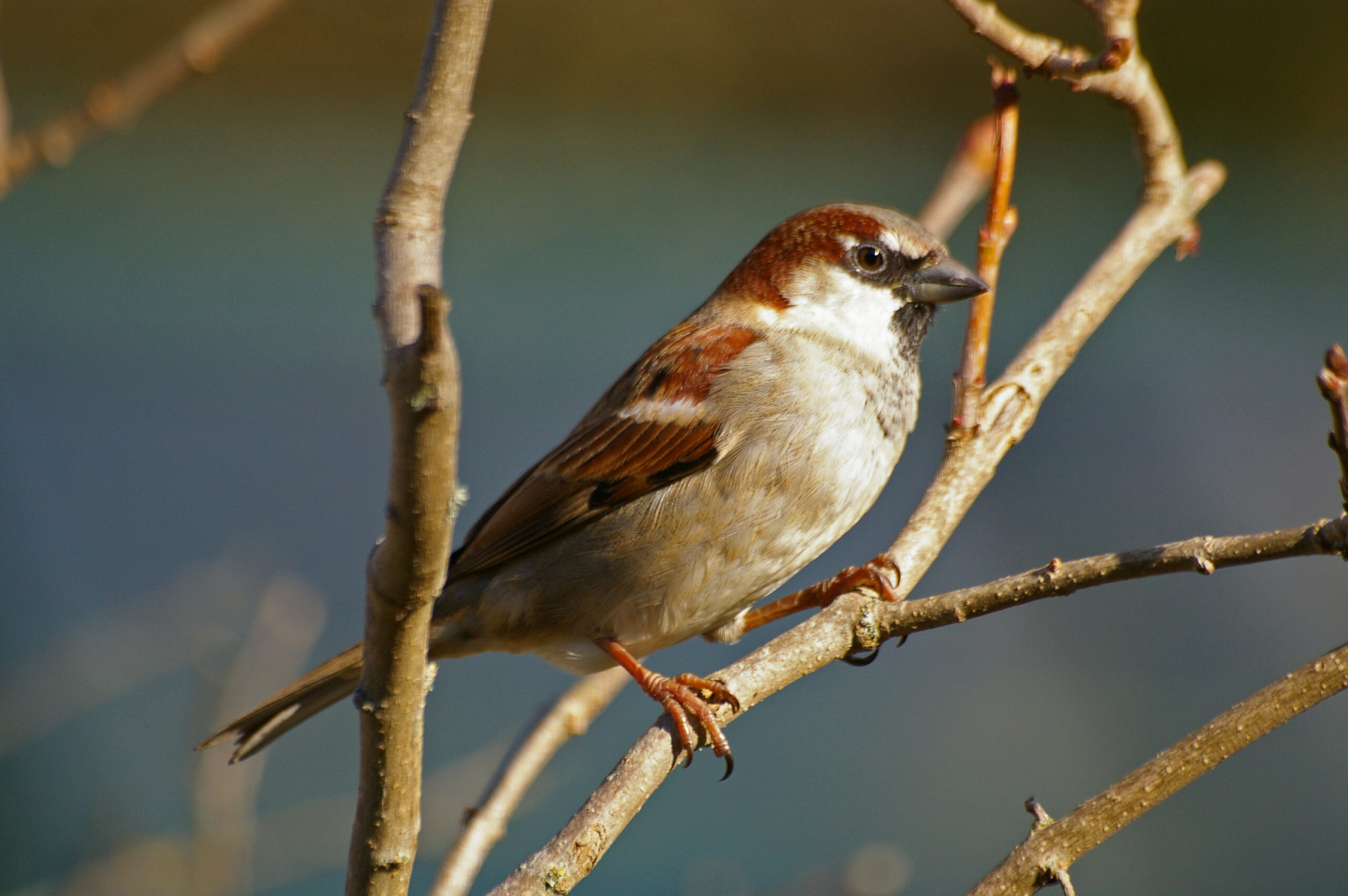
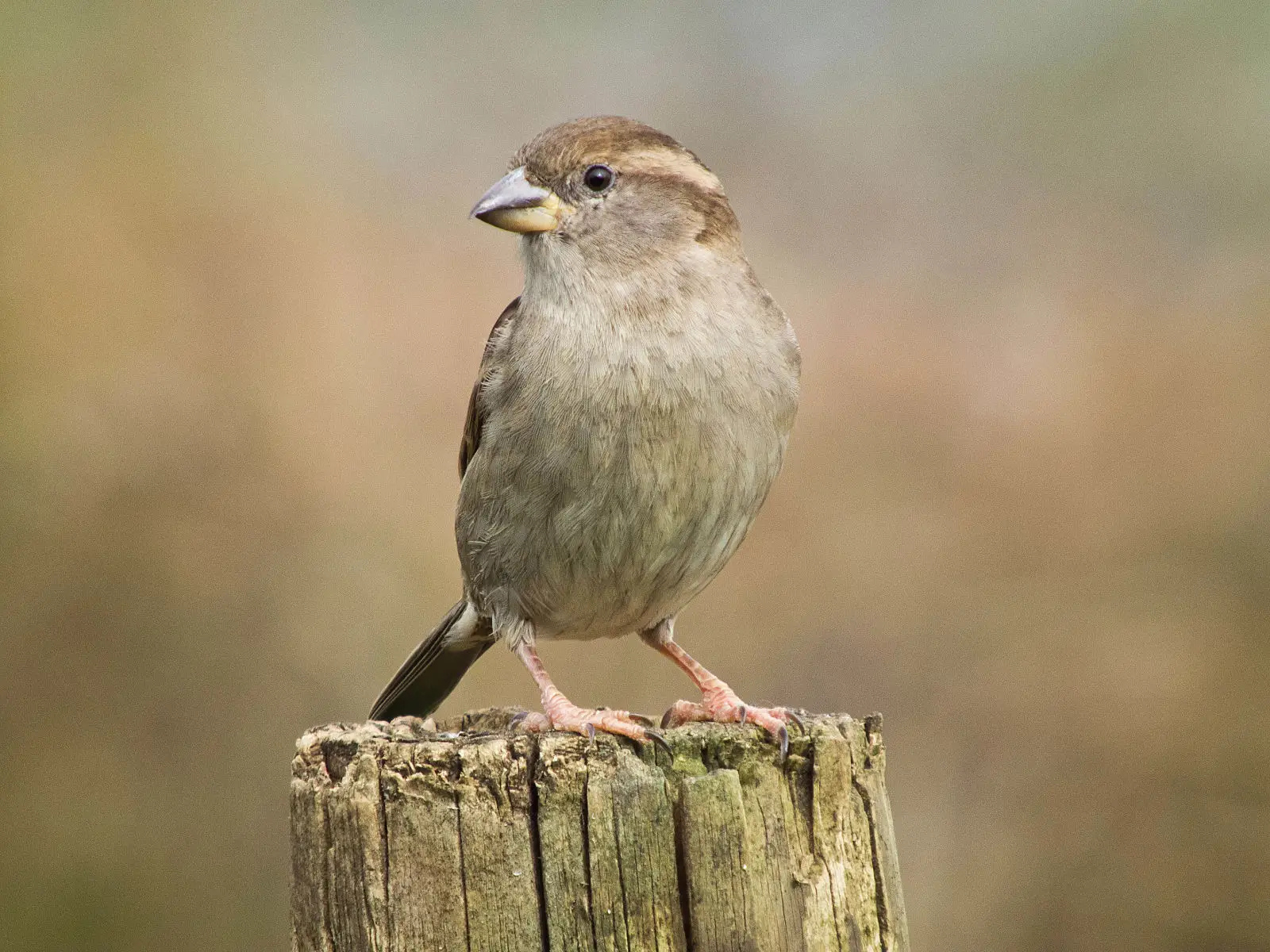
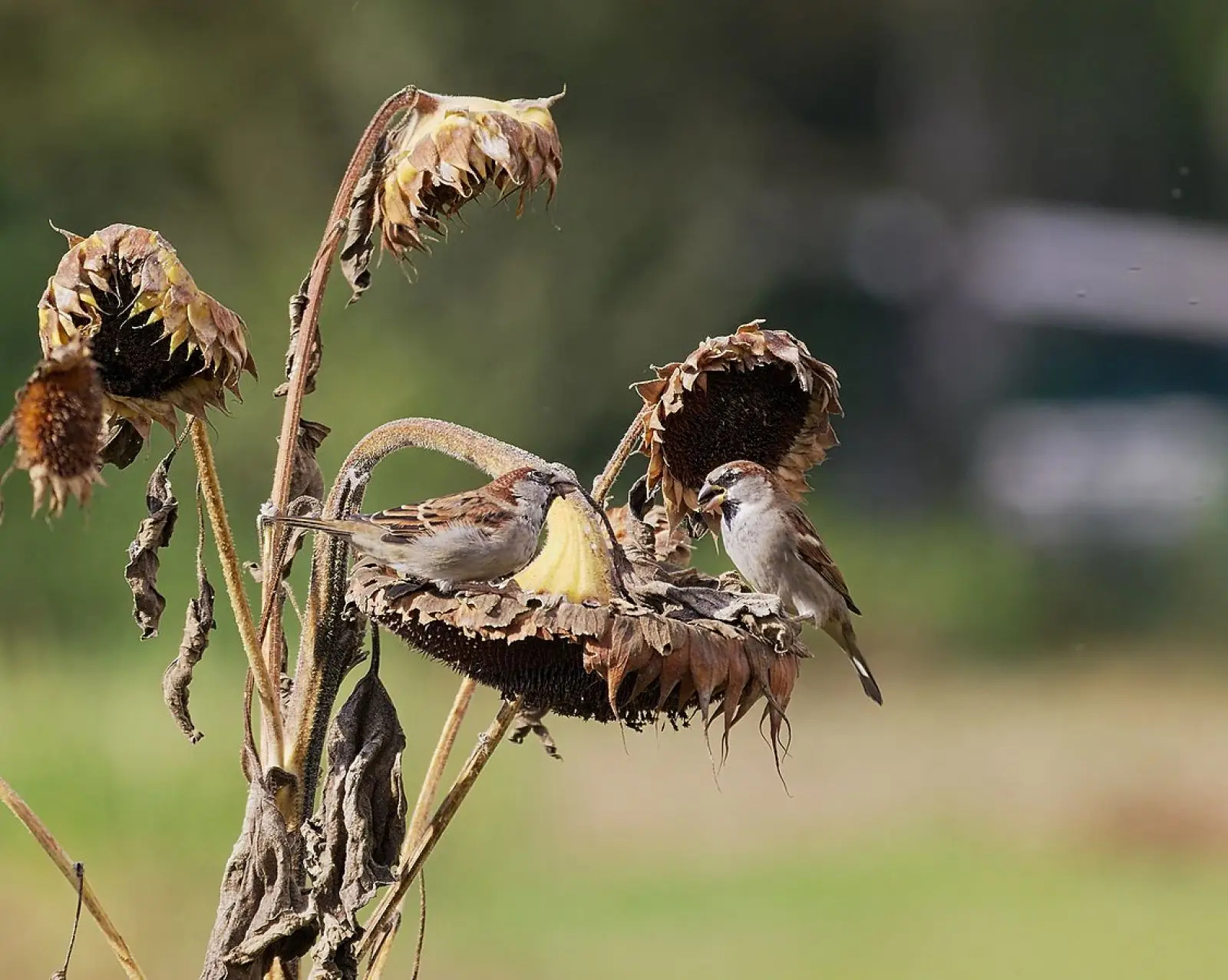
The typical ‘chirping’ of the house sparrow often gives it away from afar – it is not uncommon to hear not just a single bird, but a whole “gang”. House sparrows, also known as sparrows or ‘Karmësch’ in Luxembourgish, are sociable birds and live in flocks of several dozen.
With their loud chirping and squawking, you might often think that the birds are arguing with each other. However, this communication within the group helps them to find food – when one sparrow discovers a good feeding spot on the ground, the others rush over to fill their bellies. It also allows them to warn each other of approaching dangers or attacks, such as from sparrowhawks.
Way of life
The house sparrow is a classic synanthropic species – this means that it follows the human into his settlements. This is the case because the sparrow has been benefitting from human grain cultivation for thousands of years. This is also reflected in the Luxembourgish name ‘Karmësch’ (Kar = grain). Barns and stables provided sufficient food for the sparrow throughout the year, and it found sheltered niches for nests near human dwellings. Even today, sparrows often build small, makeshift nests in buildings where humans live – usually under eaves, in cracks in walls or under loose bricks.
The saying ‘cheeky as a sparrow’ is apt, because this adaptable species is not easily driven away and simply feels at home around humans. The Luxembourgish saying ‘D’Spatze päifen et vum Daach’ (‘this is common knowledge’) is familiar to many and shows how ubiquitous sparrows were in our towns and villages. The house sparrow is one of the most widespread bird species in the world and can be found here all year round.
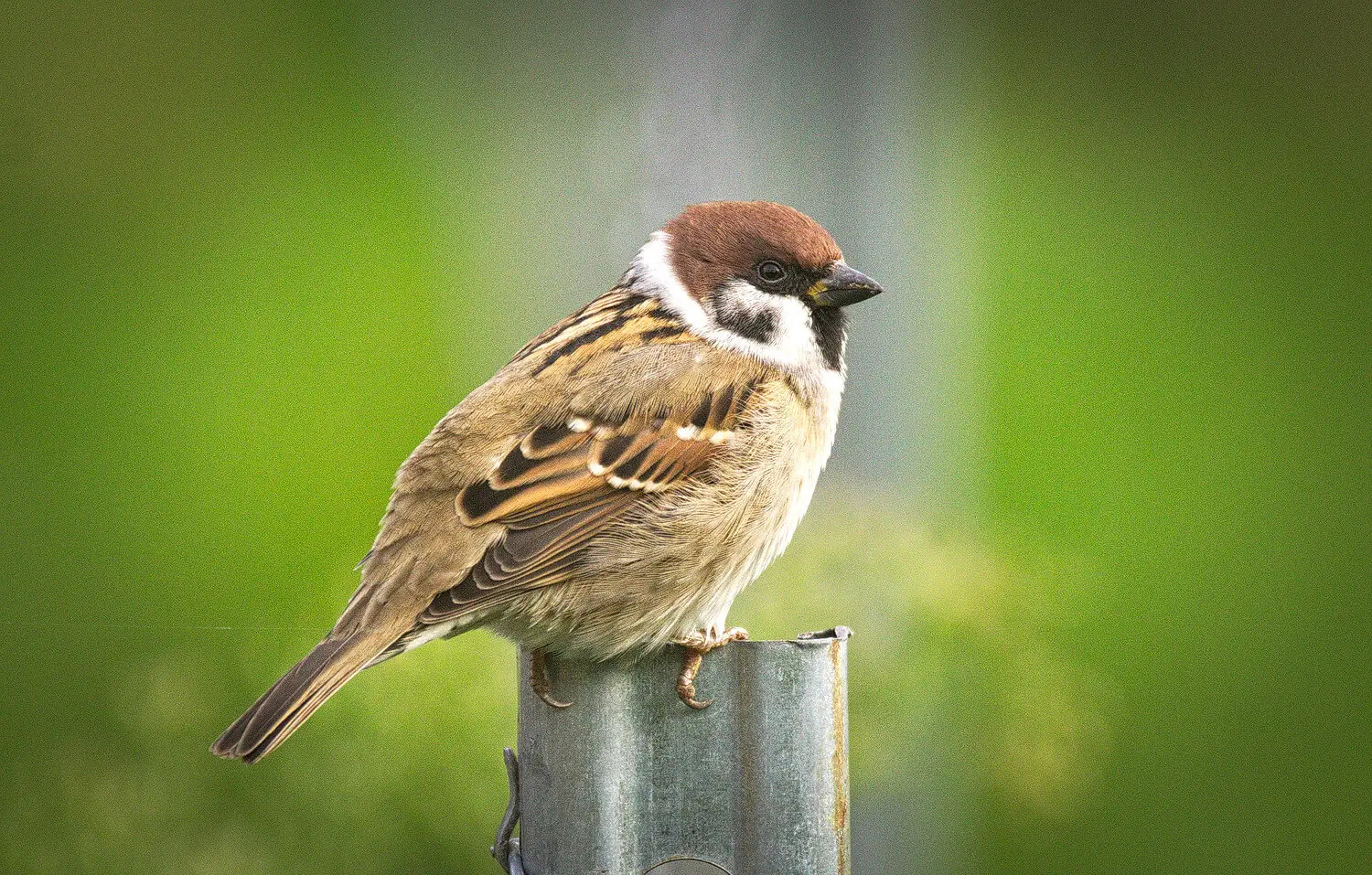
Please note: in addition to the house sparrow, there is also the tree sparrow. Tree sparrows differ from house sparrows in that there is no difference in the plumage of males and females (in house sparrows, both sexes look different). At first glance, tree sparrows look somewhat similar to male house sparrows, but they are smaller and have a chocolate brown head instead of a grey one, as well as a distinctive black cheek patch. They tend to live in open countryside or on the outskirts of villages and are not as closely associated with urban areas as house sparrows. However, it is not possible to completely divide the habitats of the two species into urban and rural areas.
(c) Animalia
Distribution in Luxembourg
In Luxembourg, the sparrow has long been ubiquitous – it has always been closely associated with human settlements. However, its population is declining – almost unbelievable for such an omnipresent and well-known bird species. The population in Luxembourg is currently estimated at 30,000-35,000 breeding pairs and has fallen by 66% in recent decades (data from natur&ëmwelt 2024). It is on the Red List of endangered bird species in Luxembourg.
Threats to the house sparrow
The main reason for the decline in house sparrow populations is modern construction methods – it can hardly find any nesting sites anymore, as insulation and renovations remove niches and crevices in walls.
Furthermore, it can no longer find enough food, as large areas are sealed off and there is a lack of green spaces within towns. Existing green spaces, in turn, usually do not provide enough food in the form of seeds or insects, as there are not enough different plants and the areas are mowed too often.
However, this pattern can also be found in the open countryside, where the general decline in plants and insects is due to modern intensive farming methods and the use of pesticides.
How can you help the house sparrow?
(c) Animalia
- Provide nesting aids:
House sparrows like to use nesting boxes. These can be integrated into new buildings or hung on existing buildings at a height of four meters or more, preferably protected under a facade projection or roof overhang. Because sparrows like to live in groups, you can also build a multi-generational house yourself using these instructions from NABU. - Preserve their quarters during renovation work on the house:
Renovation work should be carried out outside the breeding season from October to February. There are ways to provide nesting places for house sparrows in the roof base and eaves box without compromising energy-efficient renovation measures. It is also important to provide replacement breeding sites before work begins by installing nesting boxes on neighbouring buildings. - Design your garden to be close to nature:
Gardens with wild, less frequently mowed corners and native hedges are ideal. Such places offer protection, retreats and a diverse food supply in an otherwise too ‘tidy’, cleared environment. It is also important to provide a small water source for bathing, as well as a sand pit for dust bathing. Just like chickens, for example, sparrows like to bathe in sand – this helps to combat pests in their plumage.
Sources
- “Die Spatzenfibel” – a comprehensive brochure about the lifestyle and protective measures for our friendly ‘roommate’ the sparrow. From the LBV (in German): https://botschafter-spatz.de/files/user_upload/Bilder/Arten/Tiere/Vogel%20von%20A-Z/Gebaeudebrueter/Spatzenfibel/1209_LBV_Spatzenfibel_2020_web.pdf
- The house sparrow: a songbird in decline. Nature conservation syndicate SICONA (in German): https://sicona.lu/der-haussperling/
- Moineau domestique. Natagora (in French): https://oiseaux.natagora.be/fr/oiseau/moineau-domestique