






Restopolis and organic farming dossier: Responses to the arguments put forward by Mouvement Ecologique
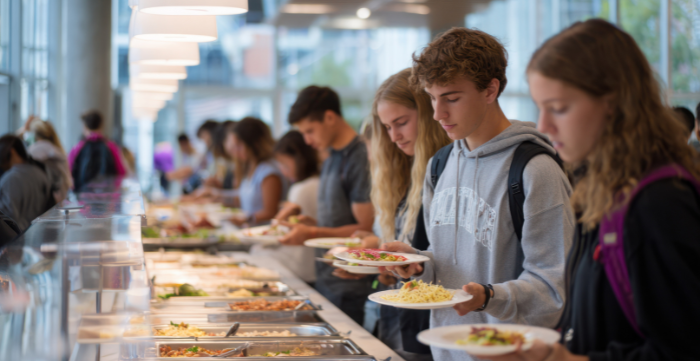
Mouvement Ecologique recently issued a statement in which we advocated that public school canteens should offer organically produced food as far as possible. This applies even if the food is not produced in Luxembourg. In other words, foreign organic products should be given preference over conventionally produced Luxembourg food in school canteens.
The Mouvement Ecologique received approval – but also critical questions.
Six key arguments put forward by Mouvement Ecologique are outlined very briefly below:
- Is foreign organic food really “better” than conventionally produced food from Luxembourg?
It is important to note that Restopolis does not purchase strawberries from South Africa. The majority of non-Luxembourg organic products come from neighbouring countries.
And the answer is yes: these organic products should be preferred in school canteens.
In short: organic farming protects nature and the environment far more – regardless of whether it takes place within or outside the country’s borders. Thanks to closed nutrient cycles, the avoidance of chemical synthetic pesticides and varied crop rotations, the negative effects on water and soil are on average much lower than in conventional farming. The animal and plant world also benefits from this. In addition, the food is demonstrably less contaminated with pesticides, among other things. Therefore: yes, organic products are preferable, especially in schools. All children should have access to particularly healthy and environmentally friendly food. Furthermore, it is a fact that transport routes only account for around 20% of CO₂emissions (this depends on the product, but is an average value). The highest emissions are associated with cultivation/production, and these are higher in conventional agriculture. Therefore, when it comes to biodiversity and climate protection, organic products are preferable to local conventional products.
- What quantities are we talking about?
The Mouvement Ecologique does not have detailed figures, but some estimates can be given. Around 80% of the food purchased by Restopolis comes from conventional farming, 20% from organic production. Of this 20%, over 60% comes from within the country. In other words, according to estimates by the Mouvement Ecologique , foreign organic goods are likely to account for only 6-7% of the total food purchased. The debate seems to revolve around these percentages… or is it more about a war of position between different opponents of organic farming?
- Shouldn’t we also consider conventional farmers in Luxembourg?
Yes, certainly, Mouvement Ecologique does that too. It is really thanks to Mouvement Ecologique that Restopolis now buys regional and organic goods. With 3 million meals served and 5 million cafeteria products sold per year, the vast majority of the benefits go to conventional agriculture. A huge sales market! For conventional and organic farming! But more certainly needs to be done (see question 4).
- Are there other sales opportunities for (all) Luxembourg farmers?
For years, the Mouvement Ecologique has been calling on the Ministry of Agriculture to give preference to food from Luxembourg in all public canteens, whether organically or conventionally produced! This is also important because schools are closed in the summer and sales of certain products slump accordingly, especially in the case of vegetables.
Instead of some people acting as if foreign organic farming were the main enemy of conventional agriculture and questioning a well-functioning system of Restopolis(), every effort should be made to ensure that all public canteens – including hospitals and nursing homes – give preference to food produced in Luxembourg and organic food! This would create a much larger market than the relatively small imports of foreign organic products. Why has the Ministry of Agriculture been inactive in this regard for years? Why are farmers’ associations not demanding this more strongly?
- Does the Mouvement Ecologique’s statement also benefit the expansion of organic farming in Luxembourg?
Definitely yes: Luxembourg is flagrantly failing to meet its own targets for the expansion of organic farming. Instead of 20% of land being farmed organically by 2025, as envisaged in the organic action plan, the figure is just over 10%. Agriculture Minister Martine Hansen believes that the targets were set too high. No, it was not the targets that were too high, but the measures to achieve them. By giving preference to organic products over conventional ones in public canteens, a clear signal is sent to farmers: it is worth switching because, among other things, there is a secure market for their products. This is the only way to achieve the targets (which, incidentally, are also our targets in the area of water protection)!
- Is the escalation in the discussions a good thing?
No, Mouvement Ecologique deeply regrets this. In its numerous statements on the subject, Mouvement Ecologique never attacks individual farmers. , we question the general orientation of (EU) agricultural policy. As a non-governmental organisation that is aware of the contribution of agriculture to the loss of biodiversity, bee mortality and the deterioration of water quality in relation to the persistent chemical TFA, this is our role! However, Mouvement Ecologique has also been campaigning for years for the Ministry to set up a round table for agriculture, in which all stakeholders – including environmental and consumer protection organisations – can participate in order to discuss existing problems. But the Minister of Agriculture is refusing to engage in this dialogue.
Translated by Deepl