






Assessment of the hunting round table (Juegddesch) by the Mouvement Ecologique
In recent weeks and months, Mouvement Ecologique has been actively participating in the hunting round table led by the Ministry of the Environment. This round table brought together environmental organisations, hunting associations, Prosilva, forest owners, farmers and ministry representatives to discuss the problems with the current hunting regulations.
From the Mouvement Ecologique’s perspective, the focus was naturally on the following facts: – Today’s game population is far too high. As is well known, more than 80% of our forest trees are damaged by the intensifying climate catastrophe. The development of species-rich, climate-resilient forests must take place now, while mature ‘parent trees’ are still able to produce seeds. However, the high density of game poses a massive threat to the regeneration of our forests. While the burgeoning wild boar population is devouring acorns and beechnuts, herbivores (roe deer, red deer, etc.) are selectively eating away at the few regrowing trees. This threatens not only the species composition but also, and above all, the genetic diversity of the growing forests. There is therefore no way around reducing the game population.
– The task is therefore to adapt hunting legislation to these new circumstances and to modernise hunting in general.
The Mouvement Ecologique, together with natur&ëmwelt in particular, has consistently advocated for appropriate reforms.
In future, the aim of hunting must be much more strongly, if not primarily, the preservation of the forest, while respecting animal welfare criteria. This is currently far from being the case.
Overall, it should be noted that the hunting round table was an extremely welcome initiative, which was also led in an extremely competent and structured manner by the Ministry of the Environment.
This made it possible to reach a consensus between all stakeholders. Certainly, Mouvement Ecologique would have expected more on some points. However, the document in its current form still represents an important step forward.
The following innovations, which can be attributed to the hunting round table, are representative of other positive developments:
– It is expressly stated that at national level, the preservation/development of resilient forest ecosystems is the most important goal, with hunting being a means of achieving this goal. This contributes to hunting being seen less as a ‘leisure activity’ and more as a means of contributing to the preservation of the forest. Foreign experts can also be expressly consulted in this regard. In this sense, strengthening the forestry administration’s powers with regard to the assessment/monitoring of game damage is a major step forward. This will lead to an improvement in the preparation of shooting plans for those authorised to hunt and allow for consistent monitoring of the measures.
Luxembourg’s forests and open land are divided into 600 hunting grounds, each with a minimum area of 300 hectares. Each landowner is also assigned hunting rights, which, however, cannot be exercised by the owner. These rights are auctioned off by the ‘hunting syndicate’, a body composed of three elected members representing all landowners in a hunting ground.
The composition of this body is to be made much more democratic and its influence on the organisation of hunting is to be increased.
It is noted that a provision is to be included in the Hunting Act stipulating that if a hunting leaseholder fails to fulfil their obligations, the hunting lease can be terminated much more easily.
However, it is extremely important to grant hunting rights in advance via the hunting syndicates. Until now, the price has been the only decisive factor in hunting rights auctions, as it was stipulated by law that these rights always had to be granted to one of the three highest bidders. This led to the ‘wildest’ hunting leases being auctioned off to the wealthiest circles in order to hunt there. It can be assumed that the reduction of the game population and the protection of biodiversity were not always the main focus.
However, the new draft law will allow other options for the awarding of hunting rights. In future, the submission of a dossier may be the criterion for acquiring hunting rights. This dossier should outline how hunting is to take place – how the shooting quotas are to be achieved. The hunting leaseholder undertakes to ensure the emergence of diverse natural regeneration within a certain period of time. This agreement is therefore a very specific and enforceable list of requirements, which on the one hand already plays a role in the granting of hunting rights and on the other hand enables the hunting syndicate to more easily terminate the agreement in the event of non-compliance by the hunting leaseholder.
– The introduction of quiet zones for wild animals by means of visitor management is intended to define undisturbed areas for the animals.
– Hunting may now be carried out at night, which is also to be welcomed. Many wild animals are nocturnal and can only be hunted during the day with time-consuming driven hunts. This applies in particular to wild boars, which can be hunted more easily and with less disturbance when sitting in a hide at night.
At present, the intended revision of the law is ‘merely’ an initial agreement between the various stakeholders. This must now be put into practice, i.e. it must result in a reform of the hunting law. Anchoring the provisions of the ‘Accord’, which are often still somewhat vague, in a legal text will undoubtedly lead to further discussion.
The Ministry of the Environment has promised that this legislative reform will be presented in 2026. The foundations for good work have been laid.
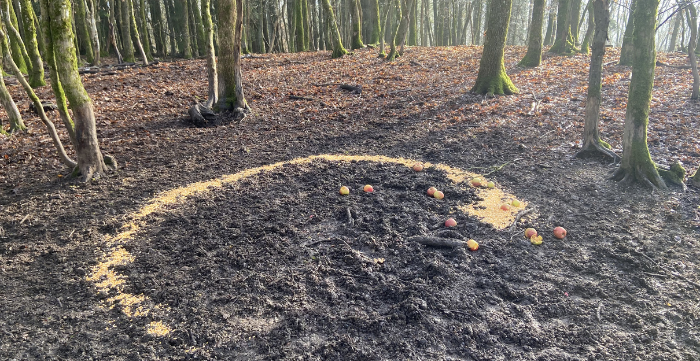
Have you seen any feeding stations? Report them to us!
Those responsible at Mouvement Ecologique, who are in charge of drafting the statements on hunting, as well as the board of directors of Mouvement Ecologique, are well aware of the fact that some people find it difficult to accept that an environmental organisation is campaigning for more hunting. The view that ‘nature regulates itself and humans should not interfere’ is, of course, close to everyone’s heart.
The forest is suffering considerably from the climate crisis, and everything must be done to mitigate it as far as possible. However, certain changes, e.g. in terms of precipitation, are taking place and will intensify.
Periods of drought, etc., are causing considerable damage to the forest.
However, the fact is that even without human intervention, i.e. hunting, our forests will no longer be able to fulfil their diverse ecosystem services in the future because the game population is too high. Here, too, the climate crisis is already playing a major role: the formerly colder
winters with long periods of frost often led to a significant reduction in game populations, especially wild boar. There is no denying that traditional conservation hunting with ‘emergency feeding’ in winter, the protection of female animals and the (sometimes illegal) introduction of foreign game species (such as mouflon and fallow deer) also contribute to the high game density. However, modern agriculture, with its abundant food supply and protection in large maize fields, also contributes to an increase in game populations.
The Mouvement Ecologique has therefore been campaigning for years for a ban on feeding. This has been successful. In the latest reform of the hunting law, feeding was banned and made a punishable offence.
Currently, only ‘baiting’, i.e. attracting game for hunting, is permitted. The Mouvement Ecologique considers this practice acceptable, as it is indispensable for ensuring that hunting is as undisturbed as possible.
So what does proper baiting look like and how does it differ from feeding?
The baiting of wild boars is normally hardly noticeable to walkers, as in this case it involves a maximum of 1 litre of grain/maize kernels covered with wood/stones so that it is not accessible to other species of game. The
baiting of wild boars is permitted all year round.
Baiting ruminants (deer, roe deer, fallow deer/mouflon) can be done with hay, carrots, beets, apples, other fruit, and some oats in quantities of up to 5 litres, but only during the deer hunting season (1 May to 31 January).
All processed food such as bread and similar items are prohibited. Baiting must be reported to the ANF and no more than one baiting site for wild boar and one for ruminants per 50 hectares (or part thereof) of forest area may be operated.
Anything other than the options described above is, in principle, feeding!
For some time, the feeding ban was respected, but the Mouvement Ecologique has now noticed that feeding is once again becoming commonplace. This is completely absurd: the aim is to shoot more game, but hunters are feeding animals and contributing to an increase in populations
Have you seen any feeding stations? Report them to us! We will forward your report to the nature conservation authorities so that action can be taken.
What we need from you:
– the coordinates of where you saw the food source;
– the date when you noticed it;
– a photo.
We will forward this to the ANF (without mentioning your name). You are also welcome to let us know if you are unsure whether it is a feeding station or feeding.
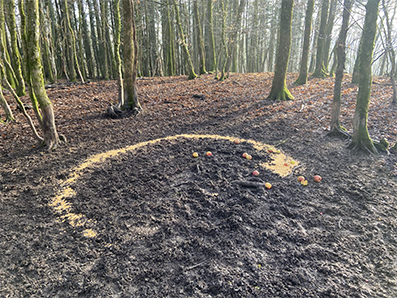
This is clearly feeding.
I
26.02.26