








Statuten
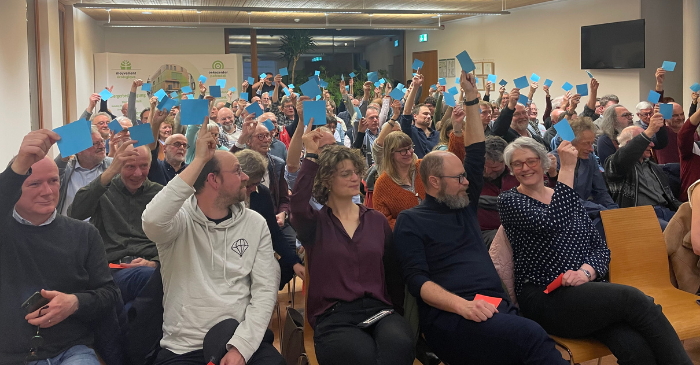
Coordinated status of the Mouvement Ecologique a.s.b.l. adopted at the 2nd extraordinary general meeting on 11 July 2025
translated by deepl.com
Mouvement Ecologique a.s.b.l. is a non-profit association, hereinafter referred to as “the Association”, governed by the Law of August 7th, 2023 on non-profit Association and foundations, hereinafter referred to as “the Law”, and by the present statutes.
CHAPTER I: NAME, REGISTERED OFFICE, DURATION AND ACTIVITIES
Article 1 – Name – registered office – duration
(1) The Association is named “Mouvement Ecologique” and has its registered office in the commune of Luxembourg.
(2) The Association pursues its activities in strict political, ideological and religious independence.
(3) It is established for an unlimited period. It may be dissolved any time.
Article 2 – Objects – activities
The Mouvement Ecologique is a grassroot movement whose purpose is to
– to work for the creation of equitable living conditions at global, European and national level and for a society that respects the interests of future generations while meeting the fundamental aspirations of human beings and taking into account planetary limits;
– to seek, promote and implement societal and economic models guided by the principle of sustainability, in the political, social, economic, cultural, educational and personal domains;
– To achieve this by raising awareness, taking action and engaging in political advocacy, particularly in order to safeguard the environment, respect ecosystems, biodiversity and protect the climate.
The Mouvemet Ecologique is guided in its pursuit of this goal by the principles of ecology and democracy in a systemic approach.
To achieve this aim, the association may in particular
– initiate, carry out and promote actions, positions, projects, analyses and scientific research in order to integrate the principles of sustainable development into the protection of the human and natural environment, the management of natural resources, agriculture, energy and soft technologies, town and country planning, mobility, the economy, finance, health, education, democratic processes and living together, as well as in relation to the socio-ecological transition;
– to develop, support and implement initiatives relating to the sustainable development of our society and to promote visions for the future in collective and individual life;
– Undertake political and awareness-raising work and call on political decision-makers, all concerned stakeholders and the general public to engage in societal dialogue on social, environmental, economic and political issues;
– issue opinions, either on its own initiative or as part of consultation and participation processes – e.g. on behalf of public bodies or other players in society – on legislative and planning projects in particular;
– issue opinions on its own initiative or as part of consultation and participation processes – including from public bodies or other players in society – on legislative and planning projects;
– take legal actions ;
– support the work of young people within the Mouvement Ecologique;
– collaborate with other national, cross-border, European and international players;
– assume responsibility for the guidance and work of Oekozenter Pafendall, and implement and manage joint projects;
– take any other initiative related to the achievement of the Association social purpose.
CHAPTER II: MEMBERS
Article 3 – Membership: number, formalities and conditions of admission, fees
(1) The Association is made up of individual full members. The minimum number of full members shall not be less than seven.
(2) Any person wishing to become a member must meet the following conditions:
– have sent an application, in whatever form, to the Association;
– adhere to the statutes of the Association and undertake to respect the objectives of the Association;
– pay the membership fee in accordance with the call for membership fees.
(3) Members are required to pay an annual subscription, the amount of which is set by the General Meeting and may not exceed EUR 500.
(4) Under certain conditions, the Board may grant a total or partial exemption from the membership fee.
(5) Each member has the right to vote at the General Meeting and is also entitled to the benefits of the Association and its services.
(6) The Association keeps at its registered office an up-to-date register of members in accordance with the conditions of Article 9 of the Law.
(7) Any member may request a copy of, or consult at the registered office of the Association, the register of members, the minutes and decisions of the General Meeting and the Board, the Association’s accounting documents and the coordinated text of the Statutes of Association. The documents and records mentioned above may not be moved. This register of members may be kept in an electronic format.
Article 4 – Withdrawal formalities / Loss of membership status
(1) Membership is lost by :
− written resignation sent by post or e-mail to the Board,
− death of the member,
− automatic resignation in the event of non-payment of the annual subscription fee within one year of the subscription fee due date,
− expulsion by the General Meeting on serious grounds or serious prejudice to the interests of the Association, decided by a two-thirds majority of those present or represented.
CHAPTER III: THE GENERAL MEETING
Article 5 – Composition, convening, votes
(1) All members shall be convened to the General Meeting by the Board at least fifteen days prior to the date of the General Meeting by post or electronic mail, stating the proposed agenda.
(2) Except in the cases provided for in these Statutes and the Law, the General Meeting shall decide without a quorum.
(3) All members have an equal right to vote at the General Meeting and resolutions are passed by a majority of the votes of the members present or represented, except where otherwise provided by the Law or the Statutes of Association.
(4) In the event of an emergency accepted by a majority of three quarters of the votes of the members present or represented at the General Meeting, resolutions may be passed outside the agenda.
(5) By decision of the Board, indicated in the invitation to the General Meeting, members may participate by videoconference or by any other means of telecommunication enabling them to be identified, and they are thus deemed to be present at the General Meeting.
Article 6 – Powers of attorney
(1) The General Meeting has the widest powers to take any decision affecting the Association.
(2) The General Meeting shall have exclusive power over the following matters
a) decisions to amend the Statutes of Association
b) the appointment and dismissal of the Board Members
c) the appointment of the President and, in the event of candidacy in accordance with Article 8 of the Statutes of Association, the General Secretary
d) to approve the budgets and accounts for the past year, after hearing the auditors’ report
e) to grant discharge to the Board Members
f) the appointment of two revisers for the forthcoming financial year, their term of office being incompatible with that of a Board Member
g) setting the membership fee for full members, which may not exceed 500 euros
h) to exclude a member
i) the submission of an application for recognition of public utility status
j) the voluntary dissolution of the Association and the appointment of a liquidator.
The resolutions and decisions of the General Meeting shall be recorded in minutes signed in duplicate bythe Board Members as defined in Article 9 of the Statutes of Association and be kept at the registered office of the Association where they may be consulted by members.
Article 7 – General Meetings – procedures
(1) The General Meeting shall meet at least once a year, no later than six months after the end of the financial year, to approve the annual accounting documents for the previous financial year and the budget for the following financial year. The financial year coincides with the calendar year.
(2) The General Meeting must be convened if at least one eighth of the members so request. The convening notice, which must state the proposed agenda, must be issued in accordance with the procedures set out in Articles 5 and 6.
(3) Any written proposal signed by at least one twentieth of the members appearing on the last annual list must be included on the agenda.
(4) Members may be represented by written proxy by another member. A member may not hold more than one proxy.
(5) The General Meeting is chaired by the Chairman of the Board or, failing to that, by the oldest member of the Board who consents. The Secretary of the Boardor any person appointed by the Board shall act as Secretary of the General Meeting.
(6) As a general rule, the General Meeting is validly constituted irrespective of the number of members present. Decisions are taken by a simple majority of votes.
(7) By way of derogation from the first paragraph, the General Meeting may only amend the Statutes of Association or declare the voluntary dissolution of the Association in accordance with the requirements of the Law.
CHAPTER IV: THE BOARD
Article 8 – Composition and functions
(1) The Association shall be managed by a Board consisting of at least five and no more than seventeen members, elected by a simple majority of the members present or represented at the General Meeting for a two-year term of office. The term of office is renewable.
(2) Nominations for a position on the Management Board must be submitted in writing to the Management Board at least five days before the General Meeting.
(3) These Managers may only be natural persons who are members of the Association.
(4) In accordance with Articles 5 to 7 of these Statutes of Association, the General Meeting must appoint, on the basis of a candidacy for this mandate, a Chairman/Chairwoman, who may be an employee of the Association.
(5) After the appointment of the Chairman/Chairwoman provided for in point (3) above, and in accordance with Articles 5 to 7 of the Statutes of Association, the General Meeting may appoint the General Secretary, if there is a candidate for this office. This position may only be held by an employee of the Association if the position of Chairman/Chairwomen is held by a non-remunerated member of the Association.
(6) The Board must appoint a Treasurer. One or more vice-chairs and a secretary may also be appointed, but these positions must be held by non-remunerated persons. These positions are determined by the Board at its first meeting after each General Meeting, for a period of one year.
(7) No person remunerated by the Association may be elected to the Board, except as provided in points 4 and 5.
(8) Voting may be by acclamation, in which case all candidates are deemed to have received a near unanimous vote. A secret ballot must be organized if 1/10 of the members present or represented support such a request.
(9) In the event of a secret ballot, only those candidates who obtain at least half of the votes of the members present or represented may become Members of the Board.
(10) The term of office of Members of the Board expires on the expiry of the term of office, death, dismissal at any time by the General Meeting or voluntary resignation in writing by simple letter to the Board.
(11) In the event of a vacancy occurring during a term of office, the Members of the Board may unanimously appoint by co-option a member to complete the term of office.
(12) The duties of the Members of the Board are not remunerated. However, the Board may reimburse its members for expenses occurred in connection with their activities for the benefit of the association
Article 9 – Powers
(1) The Board is vested with the broadest powers to perform all acts necessary and useful for the achievement of the corporate purpose, with the exception of those powers expressly reserved by these Statutes of Association to the General Meeting or by law.
(2) The Board executes the directives devolved upon it by the General Meeting in accordance with the purpose of the Association. It manages the Association’s finances and issues its publications.
(3) The Board of Directors represents and validly binds the Association with respect to third parties and in legal proceedings, either as plaintiff or defendant.
(4) The Association is validly bound to represent the Association in deeds or in court:
– by the joint signature of two of the following persons: the Chairman/Chairwoman, a Vice-Chair the Secretary/General Secretary or the Treasurer
– or by the joint signature of two of the following: the Chairman/Chairwoman, a Vice-Chair, the Secretary/General Secretary or the Treasurer and one of the persons expressly designated by the Management Board for this purpose.
Article 10 – Meetings
(1) Meetings of the Board shall be convened by notice sent to the members by the Chairman/Chairwoman or the Secretary/General Secretary or by any person appointed by the Board for this purpose, by post or electronic means at least eight days before the meeting is due to take place, whenever the interests of the Association so require or at the request of three directors.
(2) The agenda shall be attached to the notice of meeting.
(3) The Board may only validly deliberate if at least half of the members are present or represented. Decisions are taken collectively and by a simple majority of the members present or represented. In the event of a tie, the Chairman’s vote is decisive.
(4) Members may participate by videoconference or by any other means of telecommunication enabling them to be identified. Members participating by videoconference or by any other means of telecommunication enabling them to be identified are deemed to be present. The meeting held by such remote means of communication is deemed to take place at the registered office of the Association.
(5) Members may give another Member a postal or electronic mandate to represent them at any meeting of the Board. A Member may represent only one other Member at any one time.
(6) Decisions of the Board may be taken by circular with the unanimous consent of the Members expressed in writing, in duly justified exceptional cases.
(7) The resolutions of the Board are recorded in minutes which are signed in the manner set out in Article 9.
CHAPTER V: INTERNAL ORGANIZATION
Article 11 – Internal organization and rules
(1) Members may form local and regional sections, working groups and a youth section. Internal regulations, adopted by the Board, may determine how the sections and working groups operate. The operating procedures of the Youth Section are governed by special internal regulations adopted by the Board.
(2) The Association may complete the Statutes of Association with internal regulations which may not be in conflict with the Statutes of Association. These rules may contain information on the interpretation and implementation of the Statutes of Association and on matters not provided for in the Statutes of Association. The rules may be amended by a two-third majority of the members of the Board.
(3) As a general rule, no representative of a political party may sit on the Board at national level or act as spokesperson for a regional or local group or working party.
However, regarding the quality of membership on the Board, the General Assembly is empowered to decide on duly justified exceptions, provided that the independence of the Association with respect to any political party is fully preserved.
Concerning the role of spokesperson or the representation of a regional, local or working group of the Association, the decision falls under the Board, under the same condition of preserving independence from political parties.
Any person who holds a political office within a party as a member of a governing body at national, regional or local level or who has been elected by universal suffrage on his party’s list shall be deemed to be a representative of a political party.
Chapter VI: MISCELLANEOUS
Article 12 – Accounting system
(1) With reference to Article 18 of the Law, the Association’s accounting system is that which applies according to the category to which it belongs.
(2) The financial year begins on 1st January of each year.
(3) The accounts are closed on 31 December and submitted to the General Meeting for approval.
Article 13 – Amendments to the Association’s Statutes of Association
(1) The General Meeting may only validly deliberate on amendments to the Statutes of Association if the text of the amendments is indicated in the notice convening the meeting and if at least two-thirds of the members present or represented are present.
An amendment may only be adopted by a two-thirds majority of the votes of the members present or represented.
(2) However, a change in the purpose for which the Association been created may only be adopted by a majority of three quarters of the votes of the members present or represented.
(3) If two thirds of the members are not present or represented at the first General Meeting, a second meeting, convened at least eight days in advance, must be held at least fifteen days between the first and second meetings.
(4) The notice convening the second General Meeting shall reproduce the agenda, indicating the date and outcome of the first General Meeting.
(5) This second General Meeting may deliberate validly, irrespective of the number of members present or represented, and adopt amendments by the majorities laid down for the first General Meeting.
Article 14 – Financial year
The Association’s financial year begins on 1 January and ends on 31 December.
Article 15 – Dissolution
(1) The Association shall be dissolved in accordance with the provisions of Article 25 of the Law.
In the event of dissolution, the Association’s assets may not be diverted from their intended purpose and must be donated to an association with similar aims, designated by the General Meeting.
All matters not provided for in the Statutes of Association shall be dealt with in accordance with the provisions of the amended law of August 7th,2023.
Article 16 – Final provisions
For all matters not regulated by these Articles of Association, the law of August 7th, 2023 on non-profit associations and foundations shall apply.