







Detailed exchange with Minister for the Economy and Energy Lex Delles
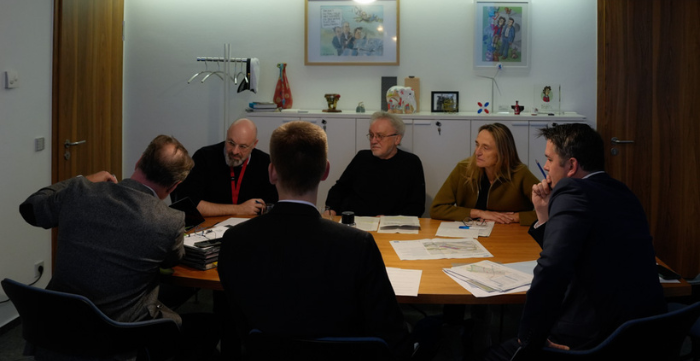
Recently, the Mouvement Ecologique held an exchange with the Minister of the Economy and Energy, Lex Delles. The discussions focused primarily on three pilot projects that the ministry is currently implementing in activity zones. These projects aim, on the one hand, to optimise mobility within the zones for all stakeholders (employers and employees), to advance the “mutualisation” of infrastructures and services (such as the shared use of central parking facilities or canteens, and co-working spaces), to foster cooperation in the field of energy (for example, the use of waste heat from one company by another), to limit land consumption through more compact building designs, to promote greening, and to create shared social spaces. A certain mix of activities within the zones is also being pursued.
The pilot projects are currently being carried out in the “Triangle vert” activity zone (Ellange-Gare), Wolser B in Bettembourg/Dudelange, and “Salzbaach” (Wiltz). It was particularly interesting to see how advanced some of the planning already is, for example in the “Triangle vert”, where an amendment to the land-use plan is intended to allow an increase in building height in order to achieve more land-efficient development.
For the Mouvement Ecologique, it is especially important that the experiences gained can be transferred and, where necessary, that current funding schemes or legal frameworks be adapted so that these key aspects can also be implemented in other activity zones across the country. This concern is shared by the ministry. Certain optimisations would become possible in particular when the “droit de superficie” (right of superficies) granted to companies on public land expires — although this period is generally 30 years. In addition, financial incentives for densification could be introduced.
The organisation of mobility within these zones was a specific topic of discussion. On the one hand, this involves optimising public transport — raising the question of mobility concepts for entire activity zones — and on the other hand, potentially channelling car traffic, for example through centralised parking facilities. For the Mouvement Ecologique, it is essential that the state develops targeted mobility concepts, also based on surveys of employees.
The organisation of energy supply was another key focus. According to the Mouvement Ecologique, requirements such as the use of waste heat should be more strongly anchored in legislation. The ministry, for its part, is working on a law on heat planning and is currently relying on dialogue with the stakeholders concerned. Energy storage was also discussed in this context.
As already mentioned, the issue of creating shared social spaces in activity zones was also raised. It is not only about using the available space more efficiently, but also about creating more social spaces for people — both inside and outside buildings — such as green areas where employees can spend their breaks, or shared indoor community spaces.
During the meeting, the Google dossier was also briefly addressed. The Mouvement Ecologique emphasised that, following the replacement of water cooling with air cooling, full transparency regarding energy consumption must be ensured. Furthermore, the significant amount of waste heat generated must be utilised. At present, according to the ministry, the legal basis for mandatory use of waste heat is lacking, but efforts are underway to ensure that this becomes possible in the future.
Overall, it was a constructive and in-depth exchange, which is to be continued at the beginning of the year. Discussions will then focus in particular on the urgently needed development of a national heat planning strategy. This is of top priority for the Mouvement Ecologique and, according to the Minister of the Economy and Energy, also represents an absolute priority.
(translated by Deepl)
19.12.25