







Nature Restoration Law – Participation in an information meeting on restoration plans
In October, the Mouvement Ecologique, together with other stakeholders from the nature conservation sector, was invited by the Ministry of the Environment to attend an information meeting on the national “restoration plans”. These restoration or renaturation plans stem from the EU Nature Restoration Regulation, adopted in 2024*. Member States must submit draft versions of their national restoration plans to the European Commission by 1 September 2026.
During the meeting, the Ministry of the Environment presented its approach to developing the restoration plans. It is welcome that, in line with EU requirements, these plans are to be drawn up through participatory processes involving relevant stakeholders and allowing for public access and scrutiny. It was somewhat disappointing, however, that the Ministry’s presentation did not go into greater technical detail regarding the drafting process (e.g. data integration or prioritisation), but instead remained rather superficial, focusing mainly on the procedural timeline and the Ministry’s obligations. Nevertheless, the sheer number of analyses and indicators that the Ministry will now have to carry out was striking and somewhat overwhelming.
The discussions that afternoon focused, among other things, on the involvement of agriculture in the development of these plans. In this context, the Mouvement Ecologique particularly emphasised the following points:
The participation of the agricultural sector is indeed crucial to the success of the restoration plans, as the greatest need for restoration lies on agricultural land (in particular open-land biotopes and habitats). As long as the orientation of agricultural policy does not change, a number of habitats cannot be restored, since they require different forms of agricultural management, such as species-rich hay meadows (with low fertiliser input and only one to two mowing dates per year).
It was also discussed how important it is for the Ministry of the Environment to receive more systematic feedback on the practical challenges encountered during the implementation of the plans and on how adjustments could be made where necessary. There appears to be a need for improvement in this regard.
Overall, the impression was that the restoration plans offer a valuable opportunity to bring together and integrate many existing plans and pieces of information into a coherent whole. At the same time, however, there is a risk that they may become mere “paper tigers” and that, without concrete follow-up on the ground, their actual impact will remain uncertain—similar to what was observed with the PNPN3. The extent to which stakeholders will be able to actively contribute will become clearer in the coming months.
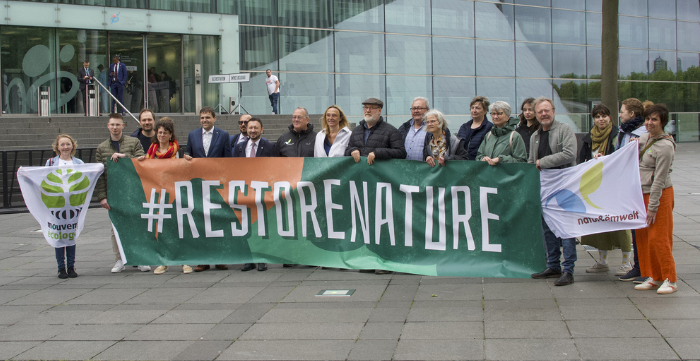
* Background: The Nature Restoration Regulation is of historic significance and its entry into force was welcomed by nature conservation organisations worldwide. After months of uncertainty, it was fortunately adopted following an unexpected turnaround (the decision of the Council of the European Union was taken on 17 June 2024 in Luxembourg; on that day, the Mouvement Ecologique, together with natur&ëmwelt, organised an action at the meeting venue on Kirchberg – see photo). Through this regulation, Member States are assigned concrete, time-staggered targets for different ecosystems to be achieved between 2030 and 2050. At EU level, for example, restoration measures are to be implemented on at least 20% of land and 20% of marine areas by 2030, and by 2050 in all ecosystems that require restoration.