







Insightful discussion with Finance Minister Gilles Roth
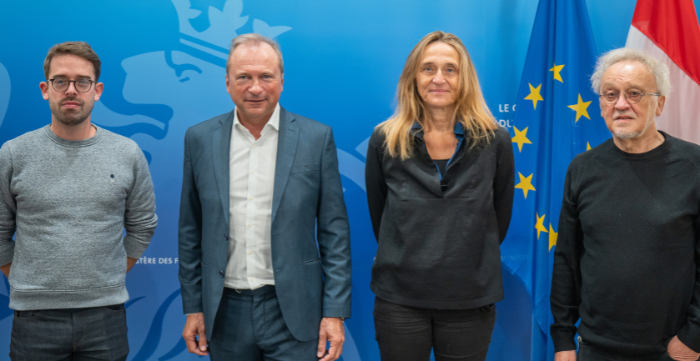
During a recent meeting with Finance Minister Gilles Roth, several files of particular relevance from an environmental perspective – and within the remit of the Ministry of Finance – were discussed.
The right of companies to sue countries before arbitration tribunals
The Mouvement Ecologique had recently published a dossier on this topic, prepared by European environmental organisations. Using 10 case studies, it shows that numerous existing agreements between states allow companies to sue countries before tribunals and claim compensation of tens or even hundreds of millions – or even billions – of euros. This can occur, among other reasons, simply because the countries concerned take decisions, for instance in favour of human rights or environmental/climate protection, which may reduce corporate profits.
Luxembourg is currently being sued for around EUR 15 billion by the Russian oligarch Mikhail Fridman (via so-called “arbitration tribunals”), as his assets were frozen following the sanctions imposed by the EU against Russia. The “Fridman case” is a particular situation, as it concerns an EU decision. In other cases presented, states were sued because they, for example, wanted to phase out fossil fuels, resulting in no or reduced profits for companies in that sector. Luxembourg has signed numerous such agreements at European level, but also bilateral ones, including among the Benelux countries. The Mouvement Ecologique therefore calls on the government to end these arbitration mechanisms in the relevant agreements (for example in the Benelux treaties) or to advocate for this at EU level.
The minister pointed out that he could not comment specifically on the Fridman case. With regard to arbitration tribunals and the agreements in general, he noted that this does not specifically fall within his competence as Minister of Finance. Moreover, Luxembourg is party to many multilateral agreements, meaning that any decision would need to be taken at EU level, and Luxembourg would not act alone.
In response to a question from the Mouvement Ecologique as to whether Luxembourg is advocating the removal of these arbitration mechanisms at EU level, he replied that this is not a priority competence of the Ministry of Finance.
Green budgeting / reduction of environmentally harmful subsidies
In several EU countries, so-called “green budgets” are being developed. These examine the extent to which the State invests its funds wisely in the area of the green transition and, conversely, to what degree public budget resources contribute to environmental degradation. The results of such analyses are striking. Larger countries each invest billions in projects which in fact fuel the climate and biodiversity crises. The Mouvement Ecologique has therefore been promoting for years that such an analysis should also be undertaken in Luxembourg and included as an annex to the State budget to inform political debate.
Gilles Roth expressed openness to such an innovation, provided that it does not challenge the current budget structure. He stated that elements of the “well-being GDP” have already been included in the 2026 State budget. His ministry is also represented in European bodies (including the OECD) working on the topic of “green budgeting”.
Climate social plan
Luxembourg is currently preparing, like all EU countries, a so-called “climate and social plan” aimed at supporting low-income households through the transition. The plan is being developed under the leadership of the Ministries for the Environment and for the Economy. A general exchange took place on this important plan. It was emphasised that, beyond the EU funds available, additional national financial resources are needed.
Environmental taxes and charges
It is a fact that significant investment is needed to achieve a socio-ecological transition. At the same time, it is recognised that causing environmental damage is currently free or too inexpensive. However, Luxembourg is at the bottom of the EU ranking when it comes to levying environmental taxes. This leads, on the one hand, to the direct or indirect promotion by the State of environmentally harmful behaviours and production methods, and on the other hand, ultimately shifts the resulting costs onto the public. For decades, the Mouvement Ecologique has therefore been advocating for a sustainable tax reform. The sectors primarily concerned would be agriculture and mobility, but adjustments would also be necessary in other areas such as energy.
According to the minister, such fiscal mechanisms could indeed be of interest. If the Chamber of Deputies were to reach a political decision on this matter, he would not oppose such an approach. The Mouvement Ecologique also raised the question of introducing a “malus” system, under which the registration of combustion engine vehicles with medium or high emission levels would be subject to financial penalties. France has introduced such a system, which can result in significant costs for citizens in these cases. However, Minister Roth questioned whether introducing such a system would receive sufficient acceptance, based on past experience.
Development of the CO₂ tax
Between 2027 and 2030, EU Member States must introduce the ETS2 emissions trading system, which will put a price on building and transport emissions. This system will replace the current CO₂ tax in Luxembourg. In the view of the Mouvement Ecologique, the transition should be as gradual as possible to allow the sectors concerned to adapt and to ensure the implementation of key social measures such as the climate-social plan.
From 2026, one tonne of CO₂ will cost EUR 45 in Luxembourg. This would also be the reference price for Luxembourg under ETS2, according to the minister. Currently, no one knows how this price will develop, especially in light of upcoming EU decisions.
Future developments will need to be closely monitored.
Overall, it was a very constructive and informative exchange.
A follow-up meeting is scheduled for January.